RMA Reform: Sheep & Beef Farmers React to New Bills
Beef + Lamb New Zealand (B+LNZ) says it welcomes the passage of the Natural Environment Bill and Planning Bill, calling the bills a positive step for sheep and beef farmers.




 increase font size
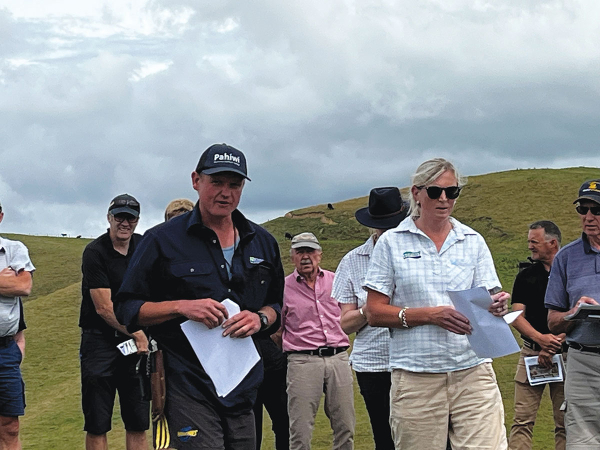 James Maher, Erewhon Station manager speaks at the field day.
A recent Beef + Lamb New Zealand ‘Farming for Profit’ field day drew about 100 people keen to hear about the policies that drove performance at Erewhon Station, located on the Taihape to Napier Road.
Owned by Rimanui Farms Limited, the original Erewhon Station was purchased in 1992, followed by Springdale in 1994. From 1996 to 2005, both units were run as one, before some of Erewhon was absorbed by Springvale, resulting in the two blocks that operate today.
Erewhon is currently 3600 effective hectares, with 60% to the north and 40% south of the highway. The contour is described as 30% steep hill, 40% medium hill country and the remainder dubbed as easy land.
The main buildings are located at 850 metres above sea level, the northern ‘flats’ sitting at around 500 metres, with the highest point at 1000m. Annual rainfall is a rather surprising 850mm, explained by living in the shadow of the mountain. The majority of stock water is collected via dams and waterways, with a small part of the property having access to reticulated water.
Winters are described as tough, lasting a full 150 days from May 1st to 30th September, with pasture growth averaging 10 kgDM per day.
Erewhon is managed by James Maher, one of nine staff, including a stock manager, four single shepherds, two general farm workers and a cook. The team is complemented by a farm technician who operates across the company’s three Taihape properties, alongside casual labour brought in as necessary.
James says winters can be brutal, “while we also have to deal with the unique shape of the station, that means stock may have to walk up to 12km, to the central, single woolshed for shearing, as using trucks is not practical given the hilly topography”.
Due to a pasture deficit over winter, great emphasis is placed on May 1st pasture covers alongside a strong reliance on accurate feed budgeting of winter crops and bought-in supplements.
Typically, a tough winter is followed, in James’ words, “by an explosive spring, that means we have high winter stocking rates to take advantage of the spring flush, both in terms of feed utilisation and maintaining pasture quality”. Currently, that winter stocking rate sits at 11.5 SU/ha.
Erewhon’s sheep operation sees 5000 “B” ewes and 6-year olds covered by Rimanui-bred Suftex rams on 1st April, 7000 “A” ewes covered by Pahiwi Romsey rams on 29th April and 4500 two-tooths mated to Pahiwi-Romney cross rams on 29th April. Finally, 5000 replacement hoggets are weighed in May, with around 3500 animals of more than 42kg mated to Suflex rams around the middle of the month.
Lambing performance across all MA and two-tooths consistently sits at 145-150% to the ram, while hogget performance sits at 80%. Overall production sees around 22,000 trade lambs, alongside 5000 replacements. Stores versus prime numbers depends on feed levels, as well as store price levels, but typically the target is to finish between 60 and 80% of animals at 18kg before the start of May, when all lambs need to be away from the property.
Looking at shearing, ewes are shorn once a year in late January, lambs are shorn in February, then hoggets are shorn again in early September. Two-tooth animals are shorn in late March, then eventually fit into the typical shearing rotation.
On the cattle front, 1300 in-calf Angus cattle are over-wintered, made up of 250 R2 first-calving heifers and 1050 MA cows. These numbers include a fully recorded stud herd, including 270 females that are synchronised for AI annually. 70 bulls are sold to the other Rimanui farms as yearling or R2s in May, as well as 15 bulls retained for commercial use at Erewhon.
All steers are finished between 2 to 2.5 years old at a target carcase weight of 315kg. Replacement heifers for the herd are selected using modern genomic technology, while all surplus heifers are sold as stores in autumn.
Cropping and supplementary feed sees around 80ha of a swede/kale mix grown for winter feed, complemented by 40ha of straight kale for winter feed, but with the option of summer grazing for lambs as required. 80ha of Raphno - the kale and radish hybrid - is used for lamb feed through summer, then locked up for winter feed. Currently, the farm is trialling plantain for improved feed quality and volumes at either end of the season.
New grass cultivators are drilled depending on how individual paddocks fit into the overall rotation. 150ha of pasture is cut for baleage or clamp in December, while around 100 tonnes of palm kernel is fed as a supplement to two-year old steers.
The station fertiliser policy comprises of a DAP application if, as James explains, “it warms up early enough”, followed by between 30 to 40kg of nitrogen, depending on price, applied by plane using a nearby airstrip.
Pasture management also use a “chemical topping technique” using low-dose glyphosate applied in early November, when cover levels sit at 1200 to 1300kg DM/ha, knocking grass growth back, but promoting improved clover growth, providing valuable feed reserves two months later in January for weaning.
“We have to use a reasonable amount of nitrogen to grow the grass we need, while our greatest agronomy challenge is dealing with thistles,” says James. “Without a doubt, throughout the year our planning is always focused at looking 90 days ahead, with a need to ensure we set up the next block of feed, which in turn then drives all our selling decisions.”
Beef + Lamb New Zealand (B+LNZ) says it welcomes the passage of the Natural Environment Bill and Planning Bill, calling the bills a positive step for sheep and beef farmers.
If you're thinking about investing in ways to push feed forward, this is the year to do it.
B+LNZ's Wormwise veterinarian Mary Bowron has won the Best Sheep and Beef Vet of the Year Award in recognition of her outstanding contribution to New Zealand’s sheep and beef sector.
With lambing underway in many regions, Beef + Lamb New Zealand is encouraging farmers to put together a wellequipped lambing kit to help minimise lamb losses, particularly in bad weather.
It's only just hit the market, but a new forage rape bred for dryland farms has already won the approval of lambs and young cattle both north and south.



Ravensdown shareholders have elected Jane Montgomery and Kate Acland to the Ravensdown Board for three-year terms, following a closely contested director election.
Federated Farmers says new legislation replacing the Resource Management Act will cut red tape, unlock investment and help grow New Zealand's export-led economy, after the Planning Bill and Natural Environment Bill passed their third reading in Parliament yesterday.
Leading figures from the major political parties will be questioned on their primary sector policies at the Rural Issues Debate at Mystery Creek Events Centre, Hamilton, on 30 September.
OPINION: Have a plan in place now!
Beef + Lamb New Zealand (B+LNZ) says it welcomes the passage of the Natural Environment Bill and Planning Bill, calling the bills a positive step for sheep and beef farmers.
A spate of southerly winds bringing cold temperatures has presented challenges for Taranaki dairy farmers.




OPINION: The same mainstream media muppets that brought you Jacindamania in 2017 have been flat out pimping for the Opportunities…
OPINION: Your old mate reckons the atrocious way farmers in the UK are treated by their lords and masters in…