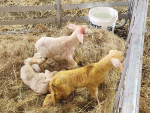
Beef + Lamb NZ's Lambing Kit Checklist for a Tough Season
With lambing underway in many regions, Beef + Lamb New Zealand is encouraging farmers to put together a wellequipped lambing kit to help minimise lamb losses, particularly in bad weather.




 increase font size
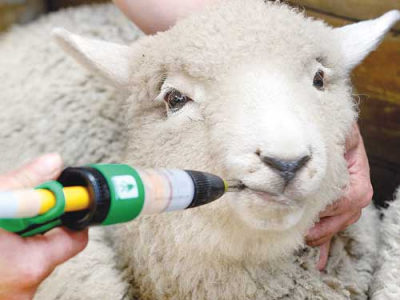 Drench resistance is already widespread on sheep farms and heading in the same direction wherever cattle are farmed.
Drench resistance is real, already widespread on sheep farms and heading in the same direction wherever cattle are farmed, says Beef and Lamb NZ.
It is embarking on an online campaign to help farmers deal with drench resistance and is providing advice on worm management and how to breed for resistance.
Drench resistance is when worm populations in an animal survive after a correctly applied dose of drench.
The resistant worms then breed, passing their resistant genes on to their offspring.
Over time – if practices remain the same – resistant worms make up an increasing proportion of the farm’s worm population, and then farmers have a problem. As that proportion increases, so does the cost to animal health, productivity and profit.
BLNZ says drench resistance costs money and creates an unfair legacy for future generations.
It advises that it makes sense to keep older, low-cost drugs working as long as possible, because they are much cheaper:
For example, dual-acting drench amounts to 7c-14c/lamb drench, triple-acting drench 20c-35c/lamb drench and Zolvix or Startect, 60c/lamb drench.
“More costly, however, is the effect of continuing to use a drench that is not fully effective. You are wasting time, effort and money.
“The next generation of farmers must be left with drench choices that work.”
BLNZ says most farmers will have resistance on farms long before they start to see a problem.
And then it will often be a major event that makes resistance obvious. For example, a cluster of lamb or calf deaths in late autumn, or a hefty problem with worms in young lambs mid to late lactation.
BLNZ says resistance is widespread in sheep and increasingly widespread in cattle.
A 2006 farm-based survey of 62 North Island beef properties revealed 94% of farms were resistant to at least one drench family. On those farms there was 92% resistance to ivermectin (‘mectin’ drenches), 76% resistance to albendazole (white drenches) and 8% resistance to levamisole (clear drenches).
The survey also found that about 20% of farms showed resistance in at least two worm species; cooperia (intestinal worms) were commonly resistant to ivermectin and albendazole and Ostertagia (brown stomach worm) resistance to ivermectin and levamisole was an emerging issue.
A 2006 survey of 112 NZ sheep farms revealed high levels of drench resistance to all drug families and 25% of farms showed resistance to ivermectin, 24% to levamisole (clear), 41% to albendazole (white) and 8% to a combination drench of albendazole and levamisole.
Specific problems identified were: Ostertagia resistance to all drench treatment options, Cooperia resistance to mectin drenches and Trichostrongylus (black scour worm) resistance to levamisole. All worm species showing a resistance to albendazole.
“In the 10 years since the 2006 survey we haven’t known much about what has happened in sheep,” BLNZ adds. “However, the cattle situation has got worse and we are now seeing resistance in the particularly nasty worm Ostertagia.”
It urges farmers to deal with facts; ideally, in the January-to-May period (when the most worm species are present in lambs), run a faecal egg count reduction tests (FECRT) alongside a larval culture.
“That will tell you how effective your current drench is. Your vet or farm consultant will be able to help you do this,” says BLNZ.
With lambing underway in many regions, Beef + Lamb New Zealand is encouraging farmers to put together a wellequipped lambing kit to help minimise lamb losses, particularly in bad weather.

Will a stronger, more coordinated voice help rebuild confidence and improve returns in the wool sector?
Matt McRae, a farmer from Mokoreta in Southland who runs a sheep, beef and dairy support business alongside a sheep stud, has been elected to the Beef +Lamb NZ Board as a farmer director.
Recent widespread autumn rain will have triggered the germination of subterranean clover seeds, and the resulting seedlings should be allowed to reach the 3–4 trifoliate leaf stage before grazing, says Beef+Lamb NZ.
The vineyards at Pyramid Farm in Marlborough’s Avon Valley have never been run of the mill, with plantings that follow the natural contours of the land, 250 metres above sea level.


In Dacre, near Invercargill in New Zealand’s South Island, Bruce Dinnington is running a dairy operation unlike any other.

A free online platform aggregating governance vacancies across rural and regional New Zealand has been launched.
Environment Minister Nicola Grigg has announced details of a new rural plastics recycling scheme.
Agricultural drone operators say that a government decision to allow lower-risk drone work without certification won’t lower standards but drive innovation and efficiency.
OPINION: Warning bells are ringing in the arable sector.
Farmgate lamb prices are down by 8%, beef cattle by 4.5% and farm expenditure up by 4.2%.

OPINION: The same mainstream media muppets that brought you Jacindamania in 2017 have been flat out pimping for the Opportunities…
OPINION: Your old mate reckons the atrocious way farmers in the UK are treated by their lords and masters in…