
Federated Farmers Backs Year 11 Agricultural Science
Federated Farmers is backing Feilding High School’s call to keep Agriculture and Horticultural Science as a standalone subject in Year 11.




 increase font size
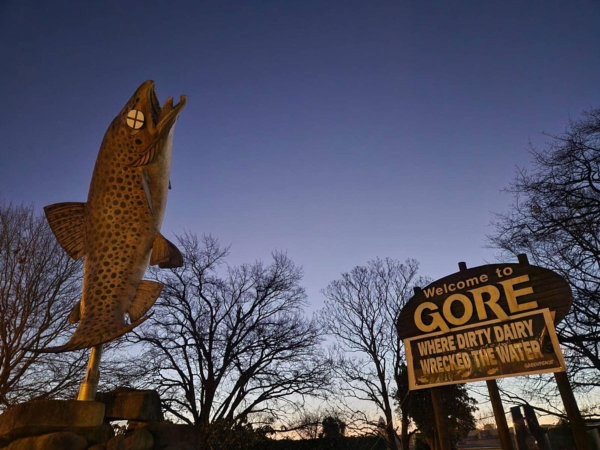 Protesters gave Gore’s brown trout stature cartoon-style crosses over its eyes. Photo Credit: Greenpeace Aotearoa
Federated Farmers is arguing for controversial environmentalist group Greenpeace to be stripped of its charitable status.
The calls follow the activist group’s publicity stunt in which protesters gave Gore’s brown trout stature cartoon-style crosses over its eyes.
Greenpeace also attached a sign to the town’s ‘Welcome to Gore’ sign, labelling the town as ‘where dirty dairy wrecked the water’.
Greenpeace Aotearoa says it’s actions were a way of spotlighting what it says is a drinking water crisis in the town and the role it claims the dairy industry has had in it.
Will Appelbe, spokesperson for Greenpeace, says the dairy industry has wrecked Gore’s drinking water and put people’s health at risk due to nitrate contamination.
“Gore’s giant brown trout statue is now a beacon of the industry’s pollution of drinking water,” Appelbe says.
Now, Federated Farmers Southland president, Jason Herrick says the group needs to be held accountable for “repeated illegal activity and the spread of harmful misinformation”.
“How can they be recognized as a charity when they’re breaking all kinds of laws trespassing on private property, vandalizing public property, and intimidating the community?” he asks.
“Last night’s vandalism of the world-famous trout statue in Gore reinforces why these activists need to lose their status as a charity,” Herrick says. “I think it’s a total abuse of charitable status.”
He says that Greenpeace’s actions are an attempt to divide the rural community and spread anti-farming propaganda.
“These activists are total cowards who are slinking around in the shadows vandalising property under the cover of darkness," Herrick says.
Federated Farmers has previously called for the Government to immediately strip Greenpeace of its charitable status after the group illegally occupied Port Taranaki.
Feds argues that charitable status within New Zealand is intended to support organisations that advance public benefit through education, relief of poverty, and other recognized charitable purposes.
Under the Charities Act, organisations need to operate for the public good and should not primarily serve political or advocacy purposes.
Herrick says that Greenpeace’s activities are clear evidence that the organization no longer meets those criteria.
"It’s become little more than an extreme activist group that’s disrupting legitimate businesses and spreading harmful misinformation - repeatedly and deliberately,” he says.
In April, Feds lodged a formal complaint with Charities Services in April, requesting a formal inquiry into Greenpeace’s conduct and eligibility for charitable status.
A copy of that request was also sent to Community and Voluntary Sector Minister Louise Upston and Minister of Internal Affairs Brooke Van Velden.
The complaint focuses on Greenpeace’s repeated involvement in premeditated unlawful protest activity, including the 2024 protests at Fonterra’s Te Rapa dairy factory. That protest saw seven individuals arrested.
"We urge Charities Services to act decisively on our existing complaint and strip Greenpeace of its charitable status quickly," Herrick says.
Herrick says it’s not just Greenpeace that needs to be held accountable for how it’s operating as a charity.
"I think Charities Services and the Government need to be held accountable too and answer some tough, but fair, questions about how this rort of the rules is being allowed to continue.
"There is absolutely no way Greenpeace should be allowed to constantly break the law and still be recognised as a charity."
Federated Farmers is backing Feilding High School’s call to keep Agriculture and Horticultural Science as a standalone subject in Year 11.

National’s pledge to introduce 19 new national standards shows the party is serious about getting Wellington out of farming, Federated Farmers says.
Mobile phone coverage and reliability are deteriorating in rural areas, and farming families are bearing the cost, according to a Federated Farmers survey.
Central Otago District Council (CODC) has voted against a plan to spread treated sewage sludge from Cromwell and Alexandra on farmland near Lauder, a decision Federated Farmers says reflects strong opposition from rural residents.
Federated Farmers has called on Central Otago District Council (CODC) to drop or vote down a plan to truck sludge from Alexandra and Cromwell to farmland near Lauder, warning it would compound an "outrageous" situation created by a separate council's decision weeks earlier.


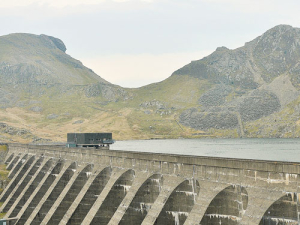
OPINION: Making it easier to collect rainwater and use it to grow crops and livestock is a no brainer.
As part of its Election 2026 coverage, Rural News asked political parties how they would help pull the arable sector out of the doldrums. Here's what they said:
Farmers are being encouraged to rethink how they manage waste on farm with the launch of ruralwastesorted.co.nz, a new website bringing together practical tips, real farmer experiences and resources.
New Zealand Winegrowers (NZW) is celebrating the India-New Zealand Free Trade Agreement (FTA) coming into force today, bringing New Zealand wine improved access to one of the world’s fastest-growing economies.
New Zealand’s red meat sector has welcomed the India-New Zealand Free Trade Agreement taking effect, which removes India’s 33% tariff on New Zealand sheepmeat.
More than 95 per cent of New Zealand’s forestry and wood exports to India can now enter tariff free as the New Zealand-India Free Trade Agreement comes into force today.




OPINION: The same mainstream media muppets that brought you Jacindamania in 2017 have been flat out pimping for the Opportunities…
OPINION: Your old mate reckons the atrocious way farmers in the UK are treated by their lords and masters in…




