
OAD arrives early in Southland
Some dairy farmers in Southland are already moving to once a day (OAD) milking because they don’t have sufficient good pasture on which to graze their stock.




 increase font size
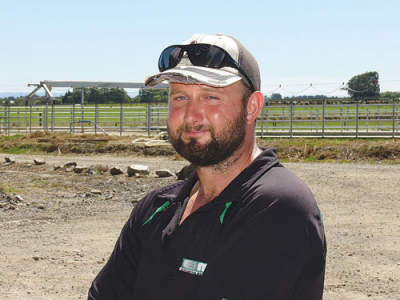 James Finnigan likes once-a-day milking because it gives him flexibility.
What’s happening with once a day (OAD) milking now, following the death last year of its great advocate professor Colin Holmes?
Dairy News went to a OAD field day in Manawatu recently to find out.
The day was beautifully fine, a rarity in this region for many months whose never-ending spring has brought little sun, only rain or cloudy windy days.
Whether it was the fine weather or the general interest in OAD, 50 farmers from the lower North Island attended.
The field day was held at a farm owned by the Finnigan partnership. Christine Finnigan has run a OAD operation in Manawatu for eight years and the family bought the farm at Linton where a field day was held a year ago. Christine’s son James and his wife Hannah are running the property as a OAD farm.
The milking platform is 115ha of which 90ha is owned by the Finnigans and a further 25ha is leased. As well they lease extra land as a runoff block. At present 310 cows – a mix of Jersey and Kiwi Cross -- are run on the property and they are targeting 100,000kgMS this season.
But Christine Finnigan says it hasn’t been an easy year.
“We had a tough spring like everyone else. The wet was horrific and it hasn’t stopped raining until about two weeks ago.
“We haven’t had more than three days sun for ages but it seems we may get a bit more in the coming days.”
With the wet, windy and cloudy weather has come slower than normal pasture growth rates. Christine Finnigan says OAD farmers face the same challenges as those on twice a day (TAD) -- poor utilisation of pasture. But things are picking up now.
The wet winter and spring and even summer have highlighted a problem on the farm which James Finnigan is in the process of solving – drainage.
James was brought up on a dairy farm and did work on one in the Tararua district before taking on this property. But he says this one with its heavy clay soils is much wetter. Since coming on the farm he’s been working on improving the infrastructure.
“We’ve redone a lot of the races, redone the effluent system plus fencing and water and have put drainage in. We have about 10ha in crops and we had planned to do a bit more but with the season it didn’t work out. We are doing another 4ha of grass now and we have turnips but they are pretty average, and one paddock of chicory plantain mix,” he says.
James says he likes OAD because of the flexibility it gives him as farmer.
“It helps free up time and you can go do a job and come back and milk the cows in the afternoon. It’s also better and less stressful for the cows and we don’t have any sick cows.”
The farm is now somewhere between system two and three; cow numbers have been cut from 340 to 310.
Finnigan says he is able to call on his mother Christine for advice and they also employ a consultant, Scott Ridsdale, to give advice. But right now his focus is on improving the drainage on the farm which he says is the major issue. The soil has become compacted and sealed over and he’s now installing a new drainage system using a combination of Nexus Novaflo and mole drains.
Some dairy farmers in Southland are already moving to once a day (OAD) milking because they don’t have sufficient good pasture on which to graze their stock.
There was a large turnout on a recent DairyNZ webinar discussing once-a-day (OAD) milking, with participants joining in from Northland and Southland and all places in between.
Once-a-day (OAD) milking was up for discussion at a recent Small Milk and Supply Herds (SMASH) field day at Massey University.
A leading once a day (OAD) farmer says her farm is set to have a record year thanks to a combination of favourable circumstances – especially the weather.
Once-a-day (OAD) milking could open a whole new labour market for dairy farmers, says a DairyNZ Wairarapa Tararua consulting officer Gray Beagley.

Farmer-owned fertiliser company, Ballance Agri Nutrients is welcoming National’s plan to negotiate security agreements with key supplier countries to protect New Zealand-bound products from export restrictions and greater supply chain certainty.

Carrfields has announced the appointment of Stu Hall to the newly created role of chief operating officer, Carrfields Ltd, reflecting the continued growth of their agribusinesses and the need to ensure the company has the leadership capacity and support in place as it pursues the emerging opportunities ahead.
New Zealand's role is not to compete with Indian growers, according to NZ Apples and Pears.
The potato industry is celebrating the success of two rising stars - James Blair, the 2026 Young Grower of the Year and runner-up and innovation award winner, Amber Davy.
Twenty-eight emerging leaders from across the horticulture sector spent two days last month learning valuable skills and connecting with industry experts.
There are five entrants in this year’s Young Horticulturist of the Year, competing in a series of technical, practical, business and leadership challenges.



OPINION: It seems Canterbury processor Synlait is still in the doldrums.
OPINION: Get offside with New Zealand First leader Winston Peters at your own peril.




