
Boosting Crop Production by Spreading Effluent
Tararua district farmer Jamie Harris milks around 400 cows using a split calving system on his farm, Crossdale Dairies.




 increase font size

A Coromandel farmer was fined $72,750 for deliberately discharging dairy effluent into farm drains that flow to the Tairua River on the Coromandel Peninsula.
Peter Craig Darrah was convicted and sentenced by Judge Jeff Smith in the Thames District Court last month for eight offences under the Resource Management Act (RMA) spanning discharges that occurred over an 11 year period between 2003 and 2014.
The prosecution, brought by Waikato Regional Council, arose after a complaint was received in August 2014 about effluent management practices on Darrah’s Hikuai Settlement Road farm near Tairua.
A council inspection found the farm’s effluent ponds were overflowing to water. Hoses were also found that appeared to be set up for the purpose of pumping effluent into farm drains. The subsequent investigation confirmed that pumping had been deliberately and routinely occurring over the previous 11 years.
An abatement notice was served on Darrah to cease the unlawful discharges. Despite this he continued with the practice. On one occasion the pumping duration was found to be approximately nine hours resulting in over 300,000 litres of effluent being discharged into the farm drain.
The drain flows a short distance before entering the Boom Stream – this stream flows about 1.5 kilometres to the Tairua River.
“In some respects this is about as bad as it gets,” says council investigations manager Patrick Lynch.
Tararua district farmer Jamie Harris milks around 400 cows using a split calving system on his farm, Crossdale Dairies.
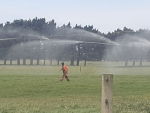
Water management is an integral component of sustainable farming practices, according to Watermetrics.
Two farmers and two farming companies were recently convicted and fined a total of $108,000 for environmental offending.
A Taupiri farming company has been convicted and fined $52,500 in the Hamilton District Court for the unlawful discharge of dairy effluent into the environment.
Founded in Germany as recently as 1977, today, the Fliegl Group employs more than 1100 workers, offering an expansive range of transport solutions, from their base in Bavaria.



National’s pledge to introduce 19 new national standards shows the party is serious about getting Wellington out of farming, Federated Farmers says.

The National Party’s policies to make it easier to grow fresh vegetables, secure reliable water and energy and simplify farm planning are practical changes that will give growers the confidence to invest, according to Horticulture New Zealand (HortNZ).
Fonterra Co-operative Group chief financial officer Andrew Murray has resigned to take up a role outside the dairy giant.
A major move is about to get underway to improve the quality and viability of dairy beef and cattle in NZ.
Veterinarians say changes to the code of welfare for dairy cattle provides a positive foundation for improved cattle welfare across the country.
Today, 15 October, is the International Day of Rural Women, which recognises rural women’s contribution to farming, communities and the environment.




OPINION: It seems Canterbury processor Synlait is still in the doldrums.
OPINION: Get offside with New Zealand First leader Winston Peters at your own peril.




