Farm races or laneways are central to moving animals, people and machinery around the farm. In the case of dairy farms, their maintenance is paramount as cows may walk considerable distances two or even three times a day.
Ideally, races need to have a slight crown in the centre that slopes away to either side, allowing surface water to drain away freely, helping to reduce the formation of holes and mud.
Over time, the preferred track of animals moving in a procession can mean the build-up of “berms” or ridges along the sides of the race, meaning water is stopped from draining.
Typically, races are maintained and reprofiled using tracked excavators to remove the build-up of material at the side of the race, which needs to be hauled away with a tractor and trailer. Research suggests that this process is relatively slow, with the machines typically able to remove around 125 metres of build-up per hour, with a rate for the machine and driver at around $225/hour.
Back in 2021, Hastings- based Landquip were displaying a range of products for horticulture at the Mystery Creek Fieldays, one of which was a sweeper designed to move orchard prunings. Several dairy farmers and contractors asked if the orchard sweeper could be used for cleaning the edges of dairy races or laneways.
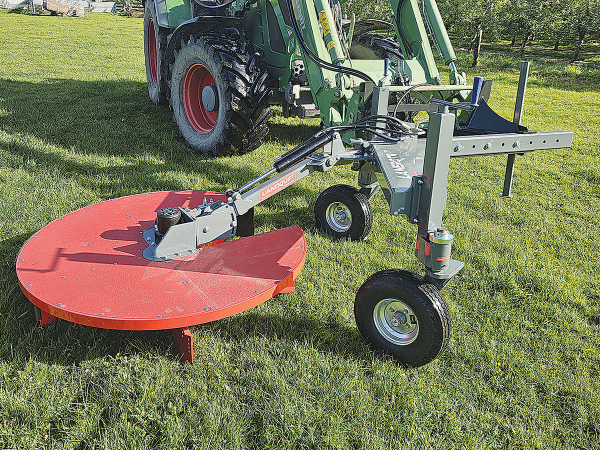
Fast forward to 2024, Landquip put their thinking caps on and came up with a solution. Built in Hawke’s Bay, the Lanerotr R1 quickly removes the soil and grass build-ups along the edges of races to restore drainage, leading to a drier surface and a reduction in lameness.
The manufacturer suggests operating at around 1 to1.5km/h it’s easy to restore up to 5km races during a working day. A 5-minute set-up time means it is easy to fit the machine during a busy day or even between milkings. Mounted on a front-end loader, using standard Euro quickhitch couplings, a robust frame carries the clearing rotor, offset to the righthand side of the tractor. The operating height is maintained via a wheeled under-carriage, with the loader in the float position to ensure the unit follows any undulating contours.
Read More:
The frame incorporates an integral breakaway pivot if the scraper paddles encounter any immovable objects, while the rotor motor is also equipped with hydraulic overload protection.
Said to be suited to a tractor with minimum 90hp, with 60 litres/ minute hydraulic oil flow, the loader will require a third service function, with a detent function to maintain constant flow to the rotor.
Offered with a 2-year warranty, the R1 features a minimum number of wearing parts, while offering the ability to restore up to 750 metres of race edges per hour, with a typical cost of $150/km, compared to a more traditional method that would run to $1,800/ km.
www.landquip.co.nz