
Outlook for dairy strong – ag trade envoy
New Zealand’s special agricultural trade envoy Hamish Marr believes the outlook for the dairy sector remains strong.




 increase font size
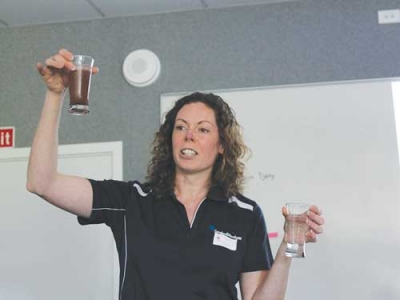 Wendy Morgan, Seales Winslow makes a point at the workshop last week.
The main message in calf rearing is to keep things simple, do those things well and pay attention to detail, says Wendy Morgan, Seales Winslow nutrition and quality assurance manager.
Morgan is presenting 15 Dairy Womens Network (DWN) Successful Calf Rearing workshops around the country; she has already held three in the South Island and kicked off the North Island workshops in Ngatea last Tuesday.
Morgan told Dairy News another key message is that what you do with the first calf should also be done with the last calf, even though there is stress and many jobs to be done. “Make sure you are finishing all your calves as consistently as possible,” she says.
Morgan told the 40 people who attended the workshop at Ngatea she is excited about calf rearing especially focussing on small changes to see what can be improved in a farm situation without spending more money. She is keen to advise small differences and changes that would improve the calving experiences. It was good to get feedback from the audience who could share their own experiences.
She said she advises on best practice but seminar attendees should not feel pressure to follow all her advice if it doesn’t suit their infrastructure, etc.
“We are talking about best practice; we are not saying you must do everything we say here.” That could make it too stressful and would not lead to successful calf rearing. Anyone with issues should feel free to ask people at the workshops, in the industry or even their neighbours for help.
However, one reason attention was needed in calf rearing is because insufficient animals were entering herds at the ideal body weight: they should enter the herd at two years at about 90% of their mature body weight – for Holstein Friesians about 500kg. A number were coming at about 400kg which was about 75% of mature liveweight.
It is important to plan and make sure everyone onfarm knows what is going on, if you can’t be there someone else may have to take over, she told the group.
Morgan told Dairy News they had had good attendances at the Successful Calf Rearing events so far. “We’ve been told they don’t normally get people turning up in Reefton and Havelock but we’ve had 20-25 people turning up to those,” she says. The workshops were held last year and people said they enjoyed them so she thinks word of mouth is getting around.
“People turn up to the Dairy Womens Network events because they know they are interactive. They tend to be people who want to help each other and give feedback. And it’s a safe place to ask questions: nobody would say ‘that’s a stupid question’. It’s a supportive group and that’s why we get a lot of numbers.”
Men have attended every workshop. Some people assume men can’t come to DWN events but they are welcome. One man came because his wife couldn’t, husbands and wives turn up together, or sometimes farm workers or owners – all sorts of different people.
Morgan, who lives in Morrinsville, has four Calf Rearing events this week starting in Kaitaia. The workshops continue in the north and south islands until July 22 – see www.dwn.co.nz/events.
The sessions include preparing a calf rearing plan, setting up calf housing and evaluating feed options. The seminar is designed for first-time rearers and the experienced.
Morgan has been working in animal nutrition for 13 years; she studied animal science at Nottingham University, an honours project looking at how different feeds for cows alter milk composition. She came to New Zealand seven years ago, initially working for NRM, and has been with Seales Winslow for two and a half years. She says agriculture does not get much focus or support in the UK. But in New Zealand there are huge opportunities.
New Zealand’s special agricultural trade envoy Hamish Marr believes the outlook for the dairy sector remains strong.
A series of free workshops on animal health are being organised next month.
Dairy Women’s Network is joining forces with Breast Cancer Cure (BCC) to raise funds for research.
Mid-Canterbury farmer Tania Burrows is winner of Dairy Women’s Network inaugural Regional Leader of the Year award.
The Fonterra 2020 Dairy Woman of the Year Ash-Leigh Campbell hopes her win will inspire young girls to join the dairy industry.


National’s pledge to introduce 19 new national standards shows the party is serious about getting Wellington out of farming, Federated Farmers says.
The National Party’s policies to make it easier to grow fresh vegetables, secure reliable water and energy and simplify farm planning are practical changes that will give growers the confidence to invest, according to Horticulture New Zealand (HortNZ).
Fonterra Co-operative Group chief financial officer Andrew Murray has resigned to take up a role outside the dairy giant.
A major move is about to get underway to improve the quality and viability of dairy beef and cattle in NZ.
Veterinarians say changes to the code of welfare for dairy cattle provides a positive foundation for improved cattle welfare across the country.
Today, 15 October, is the International Day of Rural Women, which recognises rural women’s contribution to farming, communities and the environment.

OPINION: It seems Canterbury processor Synlait is still in the doldrums.
OPINION: Get offside with New Zealand First leader Winston Peters at your own peril.




