Resilient Global Dairy Industry Overcoming Volatility
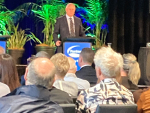
Fonterra chief executive, Richard Allen says being resilient has helped the dairy industry overcome extreme volatility in recent years.




 increase font size
 Fonterra says work done to improve its balance sheet over the last few years is paying off.
Fonterra's strategic review following two years of financial losses has received a tick of approval from ratings agency Fitch.
This month Fitch Ratings revised the co-operative’s outlook to stable from negative and reaffirmed its ‘A’ rating.
In a statement to NZX, Fonterra chief financial officer Marc Rivers says the improved outlook rating reflects the co-op’s progress following a strategic review.
“In particular, the work we’ve done to improve our balance sheet over the last few years,” he says.
Fitch says its key rating drivers included significant progress the co-op made refocusing on its core New Zealand dairy business.
“This has helped the co-operative retain its defensive traits, which previously underpinned the rating.
“Fonterra can pass on global dairy-price and foreign-exchange movements to farmers in its global ingredient business, and benefits from resilient profit margins in the consumer and food-service business when dairy prices are low. These reduce profit volatility and maintain its leverage metrics.”
Fonterra has been divesting non-core foreign assets and implemented a number of cost-cutting measures in its core business to address its profit volatility.
In 2019, it sold iconic ice cream maker Tip Top to Froneri, a joint venture between Nestle and PAI Partners for $380 million. Last year it offloaded stakes in DFE Pharma and Foodspring for $623 million.
This financial year the co-op hopes to complete the sale of China Farms for $555m.
Fitch notes that Fonterra’s completed asset sales are in line with its target to reduce gross debt by $1 billion.
As a result, leverage declined to 1.7x in financial year 2020 (FY19: 2.2x) and Fitch expects leverage to remain around this level over the medium term.
Fitch has not included any potential divestments in its base case but notes that Fonterra continues to sell off its stake in Beingmate, while DPA Brazil remains under strategic review and may also be sold.
On Covid’s impact on Fonterra, Fitch says the pandemic and civil unrest in markets such as Hong Kong and Chile had some impact on Fonterra’s business in FY20.
But Fitch expects the impact on Fonterra’s core ingredient business to be limited, as global dairy sales remain resilient.
“Fonterra’s consumer and food-service division may, however, recover slowly, as the hospitality sector across many markets remains dampened by the restrictions to manage the pandemic,” it says.
Farm Debt
Fonterra chief executive, Richard Allen says being resilient has helped the dairy industry overcome extreme volatility in recent years.

Northland farmer Greg Collins has taken over as chair of the Fonterra Co-operative Council.
Fonterra’s 2026 financial year was a year of delivery, with record volumes of milk collected, processed and shipped by the co-op.
Dairy farmers, still holding onto their Fonterra shares despite switching milk supply elsewhere or exiting the industry, now face a stricter share sell-down requirement.
Milk powder prices are continuing their merry run, firming up a potential $10/kgMS farmgate price this season.

With some farmers opposing a government-industry partnership set up to develop methane reducing products, one NZ company claims that it already has a product on the market.

During the nesting season, from September to December, industrious starlings can quickly build nests in the darker areas behind tractor and vehicle, usually close to hot engines, typically resulting in localised damage or in some cases complete write-offs.
The meat processing industry is much more collegial than it was in the past and is now more focused on common goals.
With the last couple of months having seen some potential tractor purchases put on hold with the impending election and continued input cost rises, year-to-date figures, ending September, has seen deliveries up around 5% over the same period in 2025, with a total of 2026 units.
Beef+Lamb New Zealand is calling for nominations for director roles in the Northern South Island and Northern North Island electoral districts.
Fonterra chief executive, Richard Allen says being resilient has helped the dairy industry overcome extreme volatility in recent years.

OPINION: It seems Canterbury processor Synlait is still in the doldrums.
OPINION: Get offside with New Zealand First leader Winston Peters at your own peril.