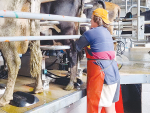
Semi-robotic milking technology to boost parlour efficiency
Waikato Milking Systems’ latest innovation, ErgoPOD is now commercially available within New Zealand and Australia.




 increase font size
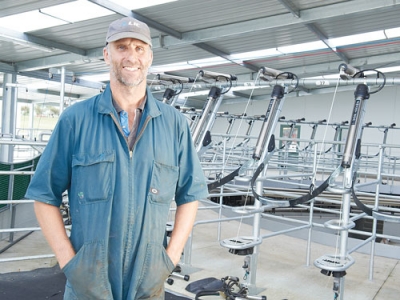 Waikato farmer Malcolm Jones.
Waikato farmer Malcolm Jones’ 450 crossbred cows were milked three times a day in a herringbone shed until last year.
The shed, on an adjacent family property on the outskirts of Matamata, served two herds, “my brother-in-law’s which went through in the morning and mine in the evening,” says Jones.
“While this worked well for both of us, it wasn’t sustainable long term and so in 2014 we decided to build a 54-bail rotary on our 150ha farm.”
The existing herringbone was from Waikato Milking Systems (WMS) so the Jones knew the company, its products and service. Jones says WMS sheds are known to be well designed, robust, easy care and don’t need much servicing.
“We wanted to have only one person in the dairy so we opted for a 54-bail Orbit rotary platform with SmartECRs (automatic cup removers) and SmartSpray (teat spraying).
“The new dairy was commissioned in November 2014 and we were pleased with how quickly the cows settled to the rotary platform.
“The new rotary has made a huge difference to the ease of running this farm. The automatic cup removers and automatic teat spraying allowed one person to comfortably milk 450 cows for the balance of the 2014 season and it will easily handle 550 in 2015-16.
“You have high expectations of quality and service when you invest in a new dairy,” Jones says. “WMS has delivered on both counts: their products are well designed, price competitive and robust.”
Waikato Milking Systems’ latest innovation, ErgoPOD is now commercially available within New Zealand and Australia.
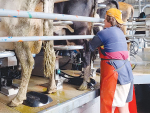
Waikato Milking Systems has unveiled the final production version of its ErgoPOD, a state-of-the-art semi-robotic technology designed to increase milking speed, productivity, and efficiency in the parlour.
While Waikato Milking Systems is committed to solving the challenges dairy farmers face with some of the world’s most innovative and technologically advanced dairy solutions, their approach differs from other companies, as their focus falls on retaining the essence of dairy farming.
Numedic Ltd has acquired a major part of Waikato Milking Systems' effluent and environmental business, including the well-known Cobra range of travelling rain gun irrigators.
OPINION: In the heartland of rural New Zealand, Waikato Milking Systems is on a transformative journey that seeks to revolutionise dairy farming practices with their latest innovation, ErgoPOD.


Dairy processors are ready to further boost New Zealand’s export earnings but want the incoming government to match their ambition with good policy.
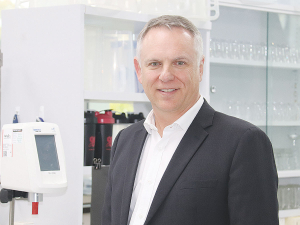
Massey University is best placed to solve the “problems” facing the dairy industry, says vice chancellor, Pierre Venter.
Synlait's longest serving employee – a man who joined the Canterbury-based milk processor even before it began processing milk – is now its newest executive.
A dairy industry leader believes eradicating the common and costly disease, Bovine Viral Diarrhoea (BVD) is within reach.
A farmgate milk price of $10/kgMS this season is firming up as milk powder prices soar and the New Zealand dollar weakens.
Federated Farmers has welcomed new rural policies released by ACT, saying they align closely with its own election priorities.

OPINION: It seems Canterbury processor Synlait is still in the doldrums.
OPINION: Get offside with New Zealand First leader Winston Peters at your own peril.




