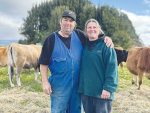
Embracing Jerseys with no regrets
The last thing most Jersey members would expect to read in the Jersey Focus is an article about the well-known Holstein Friesian and Ayrshire breeders Gary and Karen Peters of the Rock View stud, Midhirst, Taranaki.




 increase font size
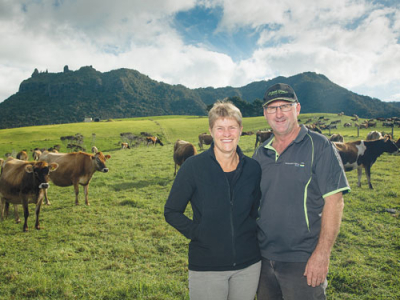 Whangarei Heads-based farmers Murray and Helen Jagger.
The jersey-cross beef business at his Whangarei Heads dairy farm is a sideline – but it is a valuable sideline, says Murray Jagger.
Last year beef sales – not including bobbies – totalled $155,000 returning back about $30,000 - 40,000, he told the recent Jersey NZ conference in Whangarei.
Jagger says they have run a Jersey-Angus cross programme at the 550ha farm on the Whangarei Heads coast for 30 years, assisted initially by his father’s Angus herd. He believes Jersey dairy farmers should pay more attention to breeding and marketing Jersey cross as a valuable sideline for their industry and also to help with the bobby calf issue.
A sixth-generation farmer, Jagger had a grandfather who ran a cream/passenger service up the harbour to Whangarei. With amalgamations, the farm has grown to milking 650 Jersey cows on 230ha and running a dairy beef operation and support block on the balance.
As part of the dairy beef operation, they carry about 250 head of Jersey/Angus-cross cattle.
“If you hadn’t realised, fat is back…. But it is not just about milk, this about the fat that affects flavour in meat.”
He claims Jersey is well placed as a breed for that and Jersey-cross calves need to be treated as part of Jersey dairy farmer’s herd improvement plan.
“We need to look at a herd improvement plan that identifies the cows that we don’t want to take replacement calves from and use better quality bulls over them and… have more of a beef focus on them because there is opportunity in that.”
Jagger says “we want cows in milk, but we can have both if we focus on the right areas”.
His farm makes ease of calving a priority.
“It doesn’t matter if it is a living bull or it is an AI bull; calving ease is paramount and a 600-day growth rate.
“I have just made my selection for bulls this year; we run all AI programme and last year we used short gestation Angus bulls. This year I am not using them because the EBV figure for birth weight was too high. It was at the upper end of what I was prepared to take so I have reverted back to an Angus beef pack that had a more acceptable birth weight.
“So I am quite critical on my birth weight EBVs.
“And I want a 600 day growth weight that is pushing that 100kg level. So somewhere from 90-100 is what I am looking for because I have a programme where I want to grow animals out at two and a half years old and I don’t want something that is not going to grow.”
The Jaggers mate the bottom percentage of cows and heifers to easy-calve high-EBV bulls. They select the cows they don’t rear any replacements from and mate them during the mating process using AI.
“We mate [most] of our top-end heifers for three weeks to AI then the balance go to Angus. We are focussing on the highest genetic material that we want. We tail off with high EBV bulls.”
Jagger says farmers should not be scared to use decent quality beef genetics with calving ease across the bottom end of the herd.
He says dairy farmers are terrible for just wanting the cheapest bull they can finish off with. “We have to set our sights a bit higher.”
The last thing most Jersey members would expect to read in the Jersey Focus is an article about the well-known Holstein Friesian and Ayrshire breeders Gary and Karen Peters of the Rock View stud, Midhirst, Taranaki.
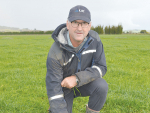
Northland farmer Murray Jagger says it's time to focus on alternative pastures that can deliver better milk and beef yield.
The perception needs to change of Jersey growth rates and finishing times, says Whangarei Heads dairy farmer Murray Jagger.
The jersey-cross beef business at his Whangarei Heads dairy farm is a sideline – but it is a valuable sideline, says Murray Jagger.
Some of the country’s top Jersey genetics from joint breeding by LIC and Jersey New Zealand are now available to farmers.


Alliance is calling for final applications for its 2027 Graduate Programme, with applications closing on Sunday 25 October.
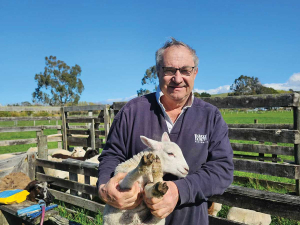
Decades piloting planes has ensured vet and farmer David Hayes is focused on safety. So, after a serious accident while welding on farm, he is sharing his experience so others can learn from it.
Canterbury milk processor, Synlait Milk has confirmed Leon Fung as its chief executive officer.
OPINION: Making it easier to collect rainwater and use it to grow crops and livestock is a no brainer.
As part of its Election 2026 coverage, Rural News asked political parties how they would help pull the arable sector out of the doldrums. Here's what they said:
Farmers are being encouraged to rethink how they manage waste on farm with the launch of ruralwastesorted.co.nz, a new website bringing together practical tips, real farmer experiences and resources.


OPINION: The same mainstream media muppets that brought you Jacindamania in 2017 have been flat out pimping for the Opportunities…
OPINION: Your old mate reckons the atrocious way farmers in the UK are treated by their lords and masters in…




