Telehandlers have made huge differences to productivity on farms and construction sites.
Not least because of their ability to lift heavy loads and place them where required with their telescopic booms.
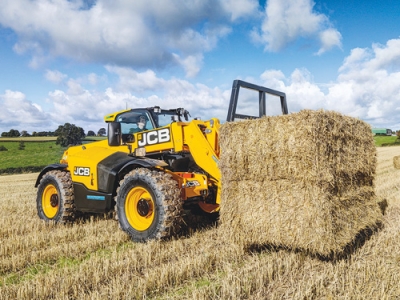
The latest development from handling specialist JCB, said to be the most significant development of their Loadall series since its introduction in 1977, is a new DualTech VT transmission option for the AgriPro series.
Until now, transmissions on this type of machine fell into the torque convertor/power-shift or hydrostatic camps. The former offers good climbing, is suited to high speeds and towing, while the latter has good pushing power at low speeds and offers superior low speed control for accurate work. In reality, each is a compromise and at times can be problematic particularly on units with multiple locations.
The development programme looked at typical usage of this type of machine and showed that workloads were generally split between handling 60% of the time, towing and roadwork for 35% and the remaining 5% of the time they were sitting idle. The resultant transmission was developed over six years and covered 10,000 'real world' testing hours.
The resultant DualTech VT transmission combines the elements of hydrostatic and torque convertor/powershift in one unit, a first for this type of machine.
In simple terms, the hydrostatic element takes care of speeds 0-19km/h, then the 3-stage power-shift unit propels the machine to the maximum 40km/h. Any changes are carried out automatically, and as there is no torque convertor in the transmission, clutch packs in the powershift sector are used to change speeds and transmit a direct drive to the machine's front wheels.
In use, speeds can be limited by selecting the top gear and, effectively, the speed you do not want to exceed. Then hydrostatic drive takes the machine from 0-19km/h, the first powershift step to 25km/h, the second step to 33km/h and the final step to the maximum 40km/h.
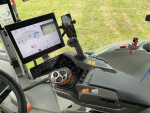
In Flexi mode, only available in the hydrostatic sector, a driving strategy can be adopted to give independent control of the engine revs and the groundspeed. Once selected, engine speed is set using the hand throttle, and groundspeed as a percentage is selected by a dial on the dashboard from where the drive pedal is used to regulate the groundspeed up to the maximum level selected.
Available in a choice of three models called AgriPro Loadall, all units are fitted with the latest 4.8L JCB DieselMax engines producing 145hp and meeting the Tier4B/Final emission regulations with the use of EGR and SCR technology. The manufacturer claims that SCR usage amounts to 3-6L/100L of diesel consumed and is dependent on workload.
In use, a choice of strategies offers Power or ECO mode, with the former offering maximum power, greater aggression and holding onto the transmission shifts for longer. The ECO setting limits maximum engine speed to 1700rpm, reduces the aggressiveness of the transmission and results in a more relaxed way of operation.
Reach on all models is 7m, with lift capacities of 3.1, 3.6 and 4.1 tonnes on the 531-70, 536-70 and 541-70 machines, respectively.
As part of the package, all units are equipped with a Smart hydraulic package offering a 140L/min, variable displacement hydraulic pump and 110L/min available for the auxiliary circuits. The system makes extensive use of re-generative hydraulic circuitry which moves oil from one side of a ram piston to the other, resulting in faster cycle times, and boom suspension results in better load retention and more operator comfort.
Further control is offered by boom end damping and a new bucket control system. This latest development is owed to 'fly-by-wire' control on machines that tends to lose the 'feel' between the bucket and the joystick controller. In practice, the control system 'shakes' the bucket to dislodge sticky materials with increased aggression as the joystick is moved further.
www.claasharvestcentre.co.nz