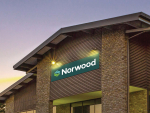
Norwood opens new Tasman dealership
Norwood has announced the opening of a new Tasman dealership at Richmond near Nelson next month.




 increase font size
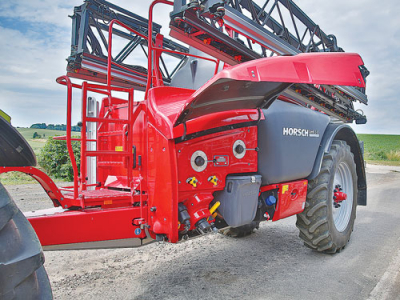 Leeb’s new range of trailed and self-propelled sprayers from German manufacturer Horsch is now available in NZ.
A new range of trailed and self-propelled sprayers from German manufacturer Horsch is now available in New Zealand from distributor Norwood.
Four trailed machines, the AX, LT Light, LT and GS – with tank sizes from 4000 to 8000L – make up the trailed Leeb range. Meanwhile, the self-propelled model PT has an 8000L spray tank.
Depending on the model, booms can be specified from 18m-42m working widths.
“Advanced boom control is one of the key advantages offered,” says Norwood brand manager Jamie Hanna. “They use sensors to read contours, making the Leeb the only sprayer in the world able to vertically manipulate each boom to follow those contours, allowing the use of wider booms in more undulating terrain.”
The levelling system is said to work consistently at the lower height of 30cm above the target. This is because nozzles are spaced at 25cm along the boom versus the traditional 50cm, which are unable to provide adequate coverage at 30cm working heights.
Lower application heights reduce spray drift by up to 80%, so more chemical hits the target and this can reduce application rates and costs.
Leeb sprayers are offered with three levels of boom control --- BoomControl Eco, BoomControl Pro and BoomControl Pro Plus. The simplest system – Eco – uses fewer height control sensors, while Pro and ProPlus have up to six sensors across the full width to offer more precise control, with individual vertical movement.
The Horsch Leeb’s Autoselect system can automatically self-select the spray rate or change nozzles to maintain the programmed spray rate. The layout sees each holder carry several different spray nozzles, chosen automatically to best fit the forward speed, the desired spray rate or a prescription map.
All Leeb sprayers can handle liquid fertiliser, and different pump options are available depending on whether they will be used primarily for chemicals or liquid fertiliser.
There is a range of suspension systems for differing terrain or road use, while steering axles provide accurate tracking in tramlines.
Continuous cleaning forms part of the operating system, while five wash programmes can be accessed on the side of the sprayer or from the cab.
More efficiency
Efficient sprayer technology will continue to be the way of the future, given the current moves by many of the industry’s key players.
The Kuhn Group, formerly a minor shareholder in French sprayer manufacturer Artec, has now bought the remaining 62% of the family owned business.
Artec builds two SP ranges -- the F40/R40 and RS 20 models. The 40 Series utilises a Deutz 6-cylinder engine with outputs from 215 to 250hp, tank sizes of 4000 or 5000L and boom widths of 24 to 50M. By contrast, the more compact 20 Series, uses a 4-cylinder Volvo engine of 180hp, tanks of 2000 or 2800L and booms from 24 to 36m.
Meanwhile, in Germany, Lemken has signalled its future in the sprayer market by buying Steketee, a maker of mechanical weed control gear.
This brand has three sprayer models -- Primus, Albatross and Vega; upgrades will see a new control system and the central integration of all major connections.
The Albatross, a mid-range professional machine with tanks of 4000 to 6200L and booms from 15 to 39m, sees key upgrades to the CCI-50 terminal, with the option of CCI apps to allow section control and tracking assistance.
All Albatross and Primus 12 models now have ISOBUS system control as standard.
Norwood has announced the opening of a new Tasman dealership at Richmond near Nelson next month.
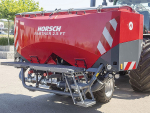
German seeding specialists Horsch have announced a new 1600- litre double-tank option that will join its current Partner FT single tank line-up.
Distributed in New Zealand by Norwood, Pichon has expanded its SV effluent tanker range with the addition of the new SV12R single-axle and SV15R tandem-axle models.
Having taken over from the previous distributor, who represented the brand for two decades, Landini New Zealand marks the beginning of a new distribution deal with Norwood, with a first look at Fieldays.
A well-known name is being showcased at Fieldays as Palmerston North-based Norwood takes over the distribution of the Landini tractor brand.

Farmer-owned fertiliser company, Ballance Agri Nutrients is welcoming National’s plan to negotiate security agreements with key supplier countries to protect New Zealand-bound products from export restrictions and greater supply chain certainty.

Carrfields has announced the appointment of Stu Hall to the newly created role of chief operating officer, Carrfields Ltd, reflecting the continued growth of their agribusinesses and the need to ensure the company has the leadership capacity and support in place as it pursues the emerging opportunities ahead.
New Zealand's role is not to compete with Indian growers, according to NZ Apples and Pears.
The potato industry is celebrating the success of two rising stars - James Blair, the 2026 Young Grower of the Year and runner-up and innovation award winner, Amber Davy.
Twenty-eight emerging leaders from across the horticulture sector spent two days last month learning valuable skills and connecting with industry experts.
There are five entrants in this year’s Young Horticulturist of the Year, competing in a series of technical, practical, business and leadership challenges.




OPINION: The same mainstream media muppets that brought you Jacindamania in 2017 have been flat out pimping for the Opportunities…
OPINION: Your old mate reckons the atrocious way farmers in the UK are treated by their lords and masters in…