
Laneve: Wools of NZ Launches Online Wool Carpet Service
Wools of New Zealand chief executive John McWhirter says its new direct-to-consumer wool carpet service, Laneve, is the next step in the development of the business.




 increase font size
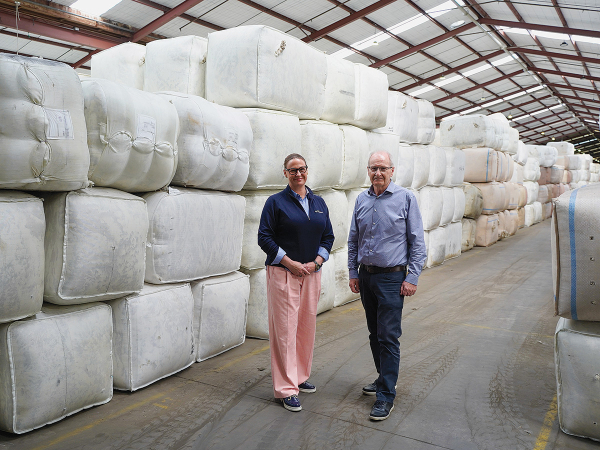 Wools of New Zealand chief executive John McWhirter and PGG Wrightson wool general manager Rachel Shearer.
Wool farmers are hoping that efforts by two leading companies to develop a more efficient supply chain would eventually boost farmgate returns.
Wools of New Zealand and PGG Wrightson (PGW) are looking at sharing wool logistics operations. The companies say the discussions are in response to the over-capacity across New Zealand's wool logistics infrastructure, following a long-term decline in production volumes that has driven up operating costs.
Federated Farmers meat and wool chair Richard Dawkins told Rural News that a move towards a more efficient supply chain is worth celebrating.
"With that in mind, this announcement is a discussion about efficiencies in a declining sector and controlling costs.
"Ideally, we would be celebrating market-driven premiums, profitability across the supply chain and subsequent returns to the farmer."
By working together, Wools of NZ and PGW aim to reduce costs, improve asset utilisation and help secure a stronger future for wool growers and the sector. Continuing to support a large under-utilised infrastructure in becoming sustainable for wool companies, some of which are owned by farmers.
Wools of NZ chief executive John McWhirter says as a 100% farmer-owned company, growers expect us to be proactive in leading change that supports a strong future for New Zealand wool.
"Coming together to seek solutions is an important step towards a more sustainable and competitive future for New Zealand's wool sector, a key contributor to the country's economy."
PGG Wrightson Wool general manager Rachel Shearer says the discussions make sense at a time when the wool supply chain is under pressure, illustrating their continued faith in the fibre and its future.
"Farmers are facing rising costs, and like them, we must control our costs too. This joint approach represents a practical example of industry leadership to discuss how to reduce duplication, improve efficiency and ensure the infrastructure that remains is fit for the future."
Dawkins agrees. With fewer half-empty wool stores, and better wool handling, the whole system becomes more efficient and cost-effective, he says.
"In turn, this should improve returns to the grower.
"Hopefully these cost savings can also be invested to realise higher value end uses and further supply chain efficiencies. To progress as a sector, a combination of corporate and farmer profitability is essential."
Dawkins says it's up to individual companies to join Wools of NZ and PGW and depends on their business structure and strategy.
"Having too many large, inefficient stores is a significant cost, and this is one way for companies to reduce that negative impact. Smaller businesses may not have those overheads."
Both Wools of NZ and PGW will continue to independently operate and compete for wool, ensuring farmers retain full choice over who they choose to transact their wool with.
After years of poor returns, the wool sector is going through some positive changes.
"We are seeing some new ideas and collaboration, which is exciting to see," says Dawkins.
"Recent improved returns have been a real boost for farmers, although a concern is that it could be driven by declining supply, rather than a significant shift in the market or supply chain."
Wools of New Zealand chief executive John McWhirter says its new direct-to-consumer wool carpet service, Laneve, is the next step in the development of the business.

For the first time in a quarter of a century, Federated Farmers has something positive to say about the Labour Party’s climate change policy leading into a general election.
Will a stronger, more coordinated voice help rebuild confidence and improve returns in the wool sector?
New Zealand's pest problem has reached crisis point, according to Federated Farmers' second National Pests Survey, which shows farmers are spending more money and effort on control — yet pest numbers keep climbing faster than they were two years ago.
After delivering a strong financial year, rural trader PGG Wrightson says the coming months will depend on customer confidence and weather.


Federated Farmers has welcomed new rural policies released by ACT, saying they align closely with its own election priorities.

Rural Contractors NZ says proposed changes to land transport rules for agricultural vehicles are a welcome response by the Government to out of date regulations which have seen members hit with huge fines.
Alliance is calling for final applications for its 2027 Graduate Programme, with applications closing on Sunday 25 October.
Decades piloting planes has ensured vet and farmer David Hayes is focused on safety. So, after a serious accident while welding on farm, he is sharing his experience so others can learn from it.
Canterbury milk processor, Synlait Milk has confirmed Leon Fung as its chief executive officer.
OPINION: Making it easier to collect rainwater and use it to grow crops and livestock is a no brainer.




OPINION: The same mainstream media muppets that brought you Jacindamania in 2017 have been flat out pimping for the Opportunities…
OPINION: Your old mate reckons the atrocious way farmers in the UK are treated by their lords and masters in…




