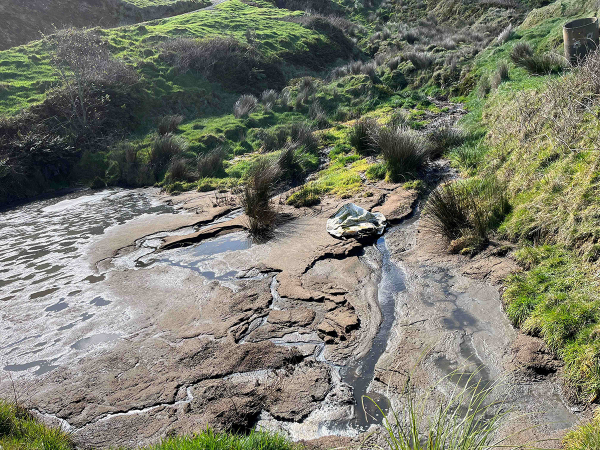
Rawhiti Environmental Park Limited has been convicted on eight charges and fined a total of $437,000 for persistent discharges of raw piggery effluent into the environment between February and October 2023.
Many of the discharges flowed into streams of the Kaimai Range, north of Te Aroha.
The convictions and fine were imposed in the Hamilton District Court last week by Judge Melinda Dickey following a prosecution initiated by the Waikato Regional Council under the Resource Management Act. This is the largest single fine imposed under the RMA in its 34-year history.
Judge Dickey also imposed an Enforcement Order on the company prohibiting any future unlawful discharges and to take certain steps to manage risks to the environment on an ongoing basis.
Between 1 February and 3 October 2023, council compliance officers carried out 50 separate inspections at the large piggery site due to serious concerns regarding the management and disposal of pig effluent.
The piggery housed the equivalent of 6500 pigs, at any given time, generating large volumes of effluent.
During 26 of these inspections, officers found effluent being discharged from the piggery infrastructure onto adjacent land then flowing into the headwaters of the Patuwhao and Hotahika streams, and on to the Waihou River.
Read More:
The council gave the company numerous notices and directions to halt the discharges over this period.
A council ecologist found the affected streams contained relatively diverse fish and macroinvertebrate populations, including at risk species, that would have been severely impacted by the toxicity of repeated effluent discharges, and that highly concentrated faecal and nutrient contamination would have further degraded the Waihou River downstream of the site.
Downstream users of the streams were seriously affected by the ongoing pollution and regularly lost the ability to take water for drinking or stock watering.
Due to the seriousness of the offending, Waikato Regional Council took the unprecedented step of applying to the Environment Court for an Interim Enforcement Order in August 2023, requiring the defendant to immediately cease unlawful discharges and take steps to reduce pig numbers and lower effluent pond volumes.
Three days after the order was granted, council officers responded to a report of another significant discharge of pig effluent into the Patuwhao Stream, requiring warnings to be given to downstream water users that the water was unsafe to use and posed significant health risks.
Waikato Regional Council regional compliance manager Patrick Lynch says the offending was "appalling".
“We simply have not had a case this bad before. The scale and frequency of these discharges, the repeated failure by the piggery owner to comply with resource consent and environmental regulation over so many months. It was terrible," says Lynch.
“There was an extreme impact on the environment and community, which has been reflected in the unprecedented level of fine imposed by the court.
“We were literally using every tool available to us under the RMA to change the behaviour on this property. It was distressing and frustrating for the council staff who were seeing the impacts on the environment each time they inspected the property.
“We continue to monitor the activities on the site. We are very happy to report that there has been much improvement. Though we have had a few complaints regarding objectionable odour coming from the site, their effluent management has generally been far more compliant and there have been improvements made to their effluent infrastructure.”
Rawhiti Environmental Park has subsequently apologised for the discharge.
In a statement released today, the company said the issues surrounding the discharge began after the departure of a lease-holder who they say "left the effluent system and infrastructure in very poor condition".
"When Rawhiti resumed control and discovered the system was severely compromised, we moved quickly to put a long-term solution in place.
"Rawhiti made the decision to keep the farm operating and invested more than $1 million in a state-of-the-art effluent system."
The statement says that Cyclone Gabrielle and the record rainfall in 2023 significantly delayed the earthworks required meaning the new system couldn't be commissioned until December 2023.
"Several contingency options also fell through for reasons outside our control," the company adds.
Rawhiti Environmental Park says the new system is now performing to a high standard and the company continues to lift its environmental performance.
"We have planted more than 2,000 native plants along waterways to enhance biodiversity and protect water quality.
"Rawhiti EPL is grateful for the support of local iwi over the past two years."
Norm Hill, trustee of Ngāti Tumutumu Iwi Trust, says the trust has been actively addressing environmental matters within the Rawhiti Environmental Park catchment.
“Rawhiti Environmental Park has worked in partnership with Ngāti Tumutumu to build a sustainable, respectful and forward-looking enterprise. This includes investing in modern effluent infrastructure, leading riparian planting and restoration with Ngāti Tumutumu involvement, and creating practical training and employment pathways for our rangatahi.
“These actions demonstrate Rawhiti’s integrity, cultural awareness and willingness to walk alongside mana whenua.
“Ngāti Tumutumu Trust strongly supports Rawhiti Environmental Park and Thomas Nabbs. The approach combines sound business practice with deep cultural respect, aiming for positive environmental, social and economic outcomes.”