Federated Farmers Warn Government Is Running Out of Time on Freshwater Reform
With six months until the election, Federated Farmers says the Government is running out of time to deliver its long-promised reform to the country's freshwater system.




 increase font size
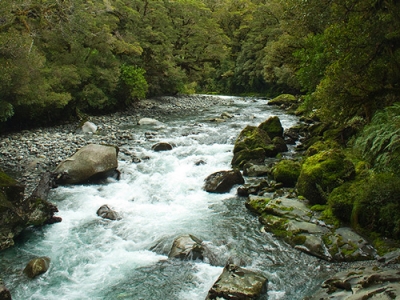 There are no ecological monitoring sites in Taranaki showing significant negative trends. Image: Paul Nelhams.
Taranaki's latest freshwater report shows ecological health for the region's waterways are showing some of the best results ever in the past 19 years.
Ecological water health is largely determined by macroinvertebrate monitoring, the number of tiny insects and species found in streams. Taranaki's 2014-15 results of macroinvertebrate (MCI) monitoring show some Taranaki sites have the best ever results since records began in 1995. These latest results were released in March 2016.
MCI is a nationally recognised measure of water health, used by many regions, which TRC scientists helped develop in the 1980s. MCI assigns a score to each species (from 1 -10), based on its tolerance or sensitivity to organic pollution, then calculates the average score of all species present at a site to rate the water quality.
Currently more than half of monitoring sites (29 out of 57) are in the two positive categories for water health – 22 have a positive and very significant MCI trend, up from 15 just three years ago, and a further seven sites have a significant positive trend.
There are no ecological monitoring sites in Taranaki showing significant negative trends.
There are also more than four times as many sites showing strong, significant improvement compared to seven years ago.
Taranaki streams and rivers showing the strongest evidence of MCI statistical and ecological improvement in water quality are:
· Kaupokonui Stream upstream of the Fonterra Kapuni factory
· Mangaehu River at Raupuha Rd
· Punehu Stream at SH45
· Kapoaiaia Stream at Wiremu Rd
· Mangawhero Stream upstream of Waingongoro River confluence
· Kaupokonui Stream upstream of STDC Kaponga WWTP
· Kapoaiaia Stream at Wataroa Rd
· Mangati Stream at Bell Block.
The full technical report, titled Freshwater Macroinvertebrate Fauna Biological Monitoring Programme 2014-2015 can be seen here: http://www.trc.govt.nz/assets/Publications/state-of-the-environment-monitoring/environmental-monitoring-technical-reports/1603850w.pdf
The findings were presented to the council's policy and planning committee on March 17, 2016.
With six months until the election, Federated Farmers says the Government is running out of time to deliver its long-promised reform to the country's freshwater system.
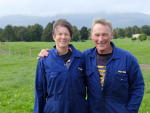
Philip and Lyneyre Hooper of the Hoopman Family Trust have tonight been named the Taranaki Regional Supreme Winners at the Ballance Farm Environment Awards.
The Taranaki region is enjoying one of the highest gross domestic product (GDP) per capita figures in New Zealand, thanks to high farmgate dairy prices.
Waikato is home to a diverse range of lakes, and experts say they urgently need better management and restoration.
OPINION: As decisions around freshwater rules edge closer, the message from dairy farmers is clear.



Horticulture New Zealand’s Board has welcomed the re-election of grower-elected directors Alistair Petrie and Doug Brown.

The bright ideas of New Zealand's primary sector have been celebrated with an announcement of the winners of the 2026 Innovation Awards.
Newly appointed Federated Farmers vice president Sandra Faulkner says she is honoured and excited to hold the role.
New Zealand's top fencers were out in force at National Fieldays this month, demonstrating their skills with the ever-reliable number 8 wire.
New Federated Farmers president Colin Hurst says he will ensure that farmer voices are heard loud and clear wherever decisions are being made.
Paynes Titus Excelsior ET, an LIC bull bred by Brad Payne and Claire Brodie in the Waikato, has won the JT Thwaites Sire of the Season 2026 Award.





OPINION: Central Hawke's Bay farmer Mark Warren recently told the Hawke's Bay Times it's time for a conversation about allowing…
OPINION: A nation that relies as heavily as NZ does on functional global shipping lanes will have to do its…