BVD Control Begins Long Before You See A Problem
Bovine Viral Diarrhoea (BVD) is sometimes viewed as a dairy industry issue, but the reality is that the disease can have serious consequences for beef breeding herds as well.




 increase font size
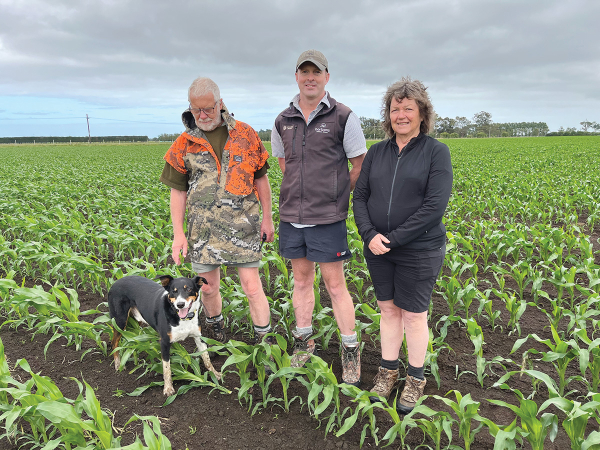 From left, detector dog Wink, handler John Taylor, Sally Linton and Horizon Regional Council’s Robbie Sicely on a farm in Taranaki.
Velvetleaf (Abutilon theophrasti) is an annual broad-leaved herb, originating in China, that can grow between 1 and 2.5 metres tall, with large heart-shaped leaves and yellow-orange flowers.
Rural News took a trip to the Taranaki earlier this month to witness detector dog Wink and his handler John Taylor on the hunt for the aggressive weed that Robbie Sicely, biosecurity manager at Horizons Regional Council describes as "the world's most cropping weed".
Velvetleaf is highly competitive and aggressive in crops such as maize and fodder beet, with studies showing that crop yields are reduced by up to 70%. Even moderate infestations that emerge simultaneously with the crop can reduce yields by as much as 25%.
Taranaki has 13 infected sites and Wink and his handler Taylor, of K9 Weed Detection searched maize or chicory crops.
Initially, Wink appeared to be covering areas in a random pattern, not unlike a sheepdog looking for sheep, but quickly became more focused when he scented the pest plant. He eventually zeroed in on a plant, barked to indicate his find, then sat to highlight the area.
At a command from Taylor, Wink then began a much more structured search pattern in the immediate idea, looking for further plants that had germinated from seeds disturbed by recent cultivator movement.
Following the recent maize planting regime in the North Island, disturbed soils offer an ideal environment for what may have been long dormant seeds to germinate.
North Island velvetleaf co-ordinator, Sally Linton, reminded growers that given its potential to decimate the New Zealand cropping sector, the economic “ripple effect” could affect the dairy, food production and export sectors.
“Fighting velvetleaf is a shared responsibility that everyone needs to be involved with, including the grower, their neighbours, contractors and seed merchants,” said Linton.
“Currently, we are just about treading water, but if we let things slip, Velvetleaf has the potential to get away from us.”
An annual weed, typically active between October and April, the invasive broad-leaved weed has been identified in over 100 North Island properties, largely in the maize crops of Auckland and the Waikato. Of particular interest to the assembled growers were 13 known incursions in the Horizons region, likely occurring on the arrival of fodder beet to the area following the wider 2016-17 fodder beet incursion in the South Island.
Emerging as a seedling, the weed quickly matures by around 100 days, identified by large heart-shaped leaves, buttery yellow flowers of about 3cm across and the eventual arrival of distinctive black seed pods of 2.5cm diameter, made up of 12-15 segments. Of particular concern is the fact that a single mature plant, that might grow to 1.2 to 1.5 metres high, can produce up to 30,000 seeds, which can survive for up to 50 years.
Linton said, “Looking at maize crops taken for silage, the seeds are not killed during the heating process of ensiling. Indeed, the use of feed pads, that in turn lead to feed waste and effluent washing, means that viable seeds can easily be spread over a wide area of a property, without realising.”
Linton suggested that anyone buying-in silage, should be inspecting source crops ahead of harvesting and confirm with suppliers that the property was velvetleaf-free. They should also confirm from harvesting contractors whether they had worked at infected properties, and if this was the case, were up to speed with appropriate hygiene practices, before moving to the next job.
The weed spreads mainly through contaminated maize, fodder beet, machinery, and livestock, so farms are at risk if neighbouring properties or purchased crops are contaminated.
The economic consequences go beyond individual farms. Infestations threaten crop quality, reduce marketable yields and can undermine domestic and international confidence in agricultural production if not controlled promptly.
Control needs to be centred around postemergent spraying, pulling juvenile plants or bagging mature specimens and safely disposing of infested material, especially when seeds are mature.
Bovine Viral Diarrhoea (BVD) is sometimes viewed as a dairy industry issue, but the reality is that the disease can have serious consequences for beef breeding herds as well.

Election years are always a concerning time for farmers, according to DairyNZ chair Tracy Brown.
Testing confirms H5 bird flu in a single northern giant petrel, found dead on a remote Cape Palliser beach in the Wairarapa, says Dr Mary van Andel, the Ministry for Primary Industries' (MPI) Chief Veterinary Officer.
Bovine Viral Diarrhoea (BVD) is sometimes viewed as a dairy industry issue, but the reality is that the disease can have serious consequences for beef breeding herds as well.
Four years since it was first detected in New Zealand, researchers and growers now know much more about management of maize pest fall armyworm (FAW).


Hawke's Bay fruit growers are being reminded of the need to prepare for whatever the El Niño weather system may bring in the coming months.
Three and a half years on from when Cyclone Gabrielle hit Hawke's Bay, some orchardists in the region are still receiving counselling to help them deal with the trauma they suffered.
South of the central Hawke’s Bay town of Waipukurau is Taniwha Station – a highly successful 550ha bull beef farming operation.
Beef + Lamb NZ funded research has shown that some simple changes to pasture management could help farmers make better use of rainfall and build resilience before dry conditions hit.
OPINION: There could hardly be a more appropriate theme for a conference than the one chosen by the red meat sector - Navigating Volatility.
When Northland leather worker Vernon Suckling started making horse saddles 50 years ago, quad bikes and side-by-side vehicles were unheard of.



OPINION: The same mainstream media muppets that brought you Jacindamania in 2017 have been flat out pimping for the Opportunities…
OPINION: Your old mate reckons the atrocious way farmers in the UK are treated by their lords and masters in…