Southerly Winds Hit Taranaki Dairy Pasture Growth
A spate of southerly winds bringing cold temperatures has presented challenges for Taranaki dairy farmers.




 increase font size
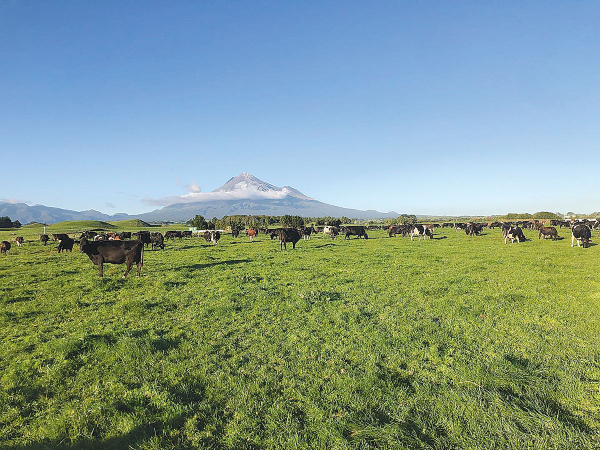 Last year dairy products became Taranaki’s top earner, fetching $1.8 billion. Photo Credit: Dairy Trust Taranaki
The Taranaki region is enjoying one of the highest gross domestic product (GDP) per capita figures in New Zealand, thanks to high farmgate dairy prices.
A new report out last week shows that the region earned $3.6 billion in exports in 2024 - largely from dairy, oil and gas, and meat products - but in recent years there has been a significant shift in where its export earnings come from.
In 2008, oil and gas exports earned the region twice as much as dairy, but in 2024 that has reversed, with dairy now earning three times as much as oil and gas.
According to the report, in the year to March 2024, Taranaki's GDP per capita was $85,362, the 3rd-highest in NZ.
Within the regional GDP by industry, the broad Forestry, Fishing, Mining, Electricity/Gas category, which is dominated by oil and gas extraction, was $2.1b, far above agriculture at $848m as of March 2024.
This reflects that oil and gas extraction has historically contributed more to output than dairy farming.
However, export values tell a different story: by 2024 dairy products became the top earner ($1.8b) with oil and gas next ($610m), reversing earlier patterns when oil and gas were larger.
In summary, oil and gas has long driven Taranaki's high GDP, but dairy's export growth in recent years has raised its share, due largely to an appreciating milk solids price.
The report, the first in a series from the team at data and insights company Dot Loves Data and ANZ, aims to provide an insightful deep dive into some of the areas that make the region tick.
ANZ New Zealand chief economist Sharon Zollner says the report highlights the value of Taranaki's strong manufacturing base and its long-standing agricultural backbone.
"This diversity helps the region navigate the ups and downs of economic, commodity and policy cycles," she says.
ANZ New Zealand managing director of business and agri, Lorraine Mapu says Taranaki's economy is undergoing a transformation, with manufacturing emerging as a key driver of future growth and resilience.
"As a bank deeply embedded in regional New Zealand, we see firsthand the ambition and capability of businesses in Taranaki.
"Manufacturing companies - like New Plymouth-based engineered timber producer Taranakipine - are investing heavily in innovation and new technology. This has boosted productivity, given these companies a competitive edge in the global market and primed them for growth."
Mapu says productivity gains and record-high prices have also enabled dairy farmers to make a substantial and growing contribution in recent years.
"By diversifying product offerings and markets, with a focus on developing high-value exports, these producers and manufacturers have played a key role in supporting our economy."
However, she says to fully realise the potential of Taranaki's transitioning economy, coordinated action at pace is needed across industry, government, and the financial sector.
"The region's strong manufacturing base, skilled workforce, ability to think differently and appetite for land use diversification offer a powerful platform for growth. With the right support, these businesses can lead the way in building a more diverse, resilient and globally connected economy."
A spate of southerly winds bringing cold temperatures has presented challenges for Taranaki dairy farmers.
Milk powder prices are keeping farmgate prices up, helping processors offset the dip in milk fat prices.
Case IH has unveiled its redesigned next generation Puma Series tractors, said to offer improvements in connectivity, operator comfort, fuel efficiency and drivability.
With forecasters advising El Niño conditions will develop through winter and strengthen into spring and summer, Ballance Agri-Nutrients is encouraging farmers and growers to think ahead about nutrient planning and be prepared to work around challenging weather conditions.


National’s pledge to introduce 19 new national standards shows the party is serious about getting Wellington out of farming, Federated Farmers says.
The National Party’s policies to make it easier to grow fresh vegetables, secure reliable water and energy and simplify farm planning are practical changes that will give growers the confidence to invest, according to Horticulture New Zealand (HortNZ).
Fonterra Co-operative Group chief financial officer Andrew Murray has resigned to take up a role outside the dairy giant.
A major move is about to get underway to improve the quality and viability of dairy beef and cattle in NZ.
Veterinarians say changes to the code of welfare for dairy cattle provides a positive foundation for improved cattle welfare across the country.
Today, 15 October, is the International Day of Rural Women, which recognises rural women’s contribution to farming, communities and the environment.


OPINION: The same mainstream media muppets that brought you Jacindamania in 2017 have been flat out pimping for the Opportunities…
OPINION: Your old mate reckons the atrocious way farmers in the UK are treated by their lords and masters in…