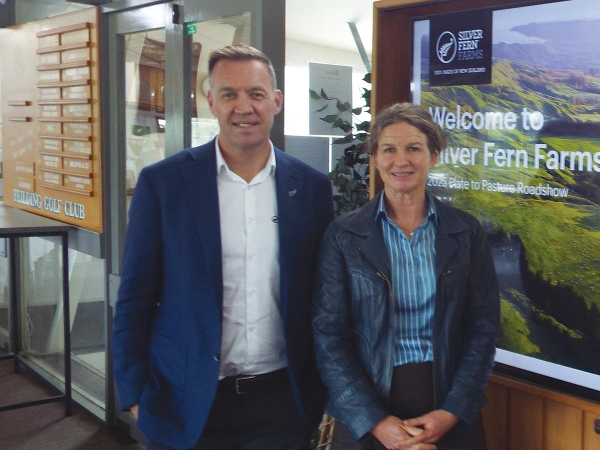
The second event in the Silver Fern Farms ‘Pasture to Plate Roadshow’ landed in Feilding last week, headed by chair and King Country farmer, Anna Nelson, and chief executive Dan Boulton.
Both had returned the previous weekend from a tour of customers in North America, UK, and Europe, culminating in flying the SFF flag at the Anuga Food and Beverage Trade Fair, held in Cologne, Germany and attracting eight thousand companies from 110 countries.
Nelson noted that customers were praising the quality of the products heading to the Northern Hemisphere, wanted more, although suggesting that lamb was getting too expensive as a customer choice in restaurants.
“In the North American market there has been a notable rise in interest in MAHA (Make America Healthy Again) with consumers focusing on quality protein from grass-fed beef to the point that labelling is now containing information on grammes of protein available,” says Nelson.
Acknowledging the past two years had been tough, she thanked co-operative members for their commitment and loyalty, alongside the need to look to the future, both in terms of their individual businesses and the wider agricultural community.
Boulton confirmed the market was positive and holding, while castigating those in the industry, who were predicting a difficult future, while noting that SFF initiatives were centred around a laser-like focus on operational agility, costs, and core efficiencies.
Digging deeper, Boulton noted, “nine months into the current financial year, revenues are up by $300m and we have taken around $60m out of our costs, on top of the $80m we removed in 2025. This has built resilience in the co-operative, but we also see thirdparty procurement agents and sales yards doing well on the rising prices but adding no value to our operation.”
Read More:
Looking at the broader picture, he confirmed that overseas buyers were worried about continuity of supply, wanted more, and had sometimes been let own.
Boulton suggested that relying on high prices for the next couple of years did nothing for resilience.
“Taking high prices now, then finding the market falls is the old way of doing business. We must think ahead, build enduring relationships with buyers, who appear to be open to longer term contracts, and support those who support us is the way forward. This might mean letting occasional buyers to fall by the way,” he said.
In North America, demand remained strong, driven by reduced local production, although subject to some volatility and changing trade conditions. Boulton confirmed that the original 10% import tariff had been passed on to buyers, but the additional 5% was challenging, particularly so, as Australia had negotiated a 10% deal.
Looking at sheep meat, Chinese demand was waning, while Europe and the UK was showing some growth. Boulton reinforced this, with an announcement that SFF had negotiated a five-year deal with UK supermarket giant Sainsbury’s who committed to taking lamb from NZ Farm Assured Programmes (NZFAP plus) farms.
Describing the company as the leader in planet-friendly retailing, the business currently operates 1475 stores in the UK, but they wanted a guaranteed supply, while at the same time encouraging farmer resilience by covering the cost of the NZFAP plus scheme. Of course, their commitment would need to be matched by quantifiable data to continue to command premium retail prices.