
Ravensdown Elects Montgomery, Acland to Board
Ravensdown shareholders have elected Jane Montgomery and Kate Acland to the Ravensdown Board for three-year terms, following a closely contested director election.




 increase font size
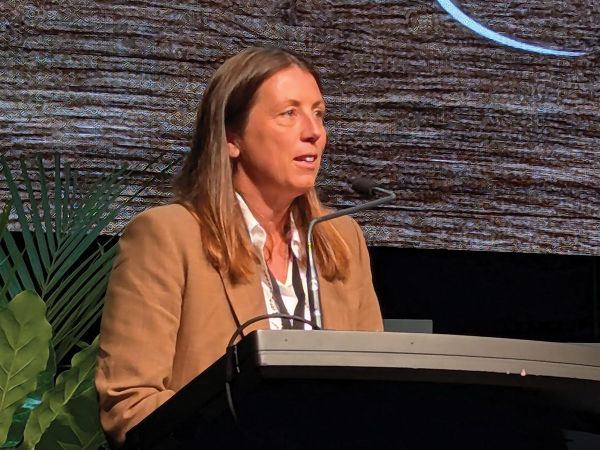 B+LNZ chair Kate Acland
The fundamentals of the beef and lamb sector are sound, despite some challenges on the horizon, says Beef+Lamb NZ chair Kate Acland.
Speaking at B+LNZ's recent Out the Gate 2026 conference in Christchurch, Acland said global demand was strong and supplies were down with decreasing stock numbers in many parts of the world.
"This is a great time to be a sheep and beef farmer. After a couple of really challenging years, we are experiencing an exceptional run in terms of pricing and most of the country has had a great growing season too."
Acland said she has just returned from the US, where she was struck by the insatiable demand for protein driven by weight loss drugs and a food system that's been turned on its head.
"US consumers are being told to prioritise red meat and this looks set to remain, because we know that where the US goes, the rest of the world tends to follow."
She said that between 12% and 20% of the American population are on the new weight loss drugs.
"Although they're eating less in terms of quantity, they need a really high quality protein, which is something that we are so well placed to meet as a country."
Acland said preferential trade agreements had been incredibly important over the last five years as markets had changed quickly and global uncertainty has become the new norm.
The recently-signed India free trade agreement opened up another "enormous" potential market for sheep meat that had been largely closed due to a 53% tariff.
Beef+Lamb NZ would soon be releasing an independent report on the economic and social contribution of the red meat sector, which Acland said will reinforce its significant impact on the New Zealand economy.
"Without giving everything away now, I will tell you this, and it will be no surprise: Pastoral farming is the lifeblood of New Zealand's economy. When farming does well, the rest of New Zealand does well.
"Farmers are major employers and spenders and in the 25/26 season, our economic service estimates that sheep and beef farmers generated $8 billon of value on farm, which is nearly $2 billion up on the previous year.
"We know that sheep and beef farmers spend about 90% of what they earn in local communities, and that's an average of $16 million a day on goods and services, mostly in regional centres which flows through to wider New Zealand.
However, Beef+Lamb continued to advocate for "balance" in governmental policy settings to allow the sector to continue to play its role in driving New Zealand's economy.
Coinciding with the conference, B+LNZ released a report comparing New Zealand's climate change policies for agriculture with the rest of the world.
"What it shows is that New Zealand's current approach - not intending to price farmers for emissions or to put agriculture in the ETS - is very much in line with other countries.
"But nearly every other country that is considering emissions from agriculture is either subsidising the use of new technologies or providing incentives such as access to carbon credits, which puts New Zealand at a disadvantage."
Ravensdown shareholders have elected Jane Montgomery and Kate Acland to the Ravensdown Board for three-year terms, following a closely contested director election.
Beef + Lamb New Zealand (B+LNZ) says it welcomes the passage of the Natural Environment Bill and Planning Bill, calling the bills a positive step for sheep and beef farmers.
As farmers begin thinking about establishing next year’s winter forage crops, Beef + Lamb NZ is encouraging farmers to carefully consider what crops they are planting and where.
Farmgate lamb prices are down by 8%, beef cattle by 4.5% and farm expenditure up by 4.2%.
Red meat farmers are welcoming Labour’s plan to review the Emissions Trading Scheme and not to campaign on pricing agricultural emissions.



Federated Farmers has welcomed new rural policies released by ACT, saying they align closely with its own election priorities.

Rural Contractors NZ says proposed changes to land transport rules for agricultural vehicles are a welcome response by the Government to out of date regulations which have seen members hit with huge fines.
Alliance is calling for final applications for its 2027 Graduate Programme, with applications closing on Sunday 25 October.
Decades piloting planes has ensured vet and farmer David Hayes is focused on safety. So, after a serious accident while welding on farm, he is sharing his experience so others can learn from it.
Canterbury milk processor, Synlait Milk has confirmed Leon Fung as its chief executive officer.
OPINION: Making it easier to collect rainwater and use it to grow crops and livestock is a no brainer.





OPINION: The same mainstream media muppets that brought you Jacindamania in 2017 have been flat out pimping for the Opportunities…
OPINION: Your old mate reckons the atrocious way farmers in the UK are treated by their lords and masters in…




