Turning data into dollars
If growing more feed at home adds up to $428 profit per tonne of dry matter to your bottom line, wouldn’t it be good to have a ryegrass that gets you there quicker?




 increase font size
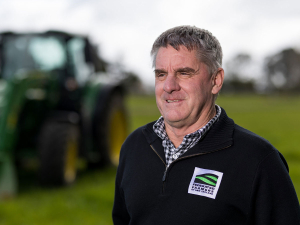
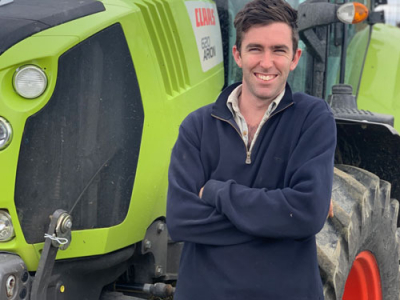 Marton Young Farmers member Mike Hancock.
Manawatu agricultural contractor Mike Hancock is helping to feed some of the world’s most stunning and endangered animals.
The 23-year-old is a joint operations manager for Bruce Gordon Contracting, north of Marton.
Earlier this year the company received a phone call from Auckland Zoo, almost 500 kilometres away.
The zoo was after a new supplier of hay and lucerne to feed its Asian elephants, zebras, rhinos, giraffes and nyalas.
“Typically we field calls from farmers or strawberry growers. Getting one from Auckland Zoo was very exciting,” said Mike, who's a member of Marton Young Farmers.
“Bruce Gordon had a chat with them and after a couple of phone calls and a few emails it was all go.”
Auckland Zoo is home to 135 species and more than 1400 animals.
Since April, on a bi-monthly basis, it’s been delivering required quantities of feed sourced from Manawatū and Canterbury farms.
“We supply them with all their hay and lucerne for their elephants and ungulate species,” said Mike.
“They chew through quite a bit, but they are great to deal with.”
“We are really focused on the quality of our product,” he said.
Auckland Zoo is home to some of the world’s most endangered animals. Quality control and biosecurity is a top priority.
The deal isn’t Bruce Gordon Contracting’s first foray into the Auckland market.
The company supplies 54 truck and trailer loads of straw within a three month period to strawberry growers and mushroom farms.
“We try to do three unit loads a week. We cart as much as we can ourselves, but we also use a local freight company to give us a hand,” said Mike.
“On a truck and trailer we can usually fit 750 conventional bales, 72-78 big square bales or 44-50 round bales.”
Making hay and baleage is the “bread and butter” of Bruce Gordon Contracting.
The company produces between 6000-8000 round bales and 8000-12,000 square bales in a typical year.
Mike started with the company as a casual driver and is in his second season as joint operations manager.
“My role involves driving, speaking with clients, and sourcing work for our team of staff which can climb to 13 people during the peak,” he said.
“Bruce takes care of the majority of the admin, which is really good.”
The NZ Young Farmers member has always had a passion for tractors and big machinery.
He got his learner licence and left school at 15, securing his first job on a sheep, beef and mixed cropping property near Marton.
“I bought a moped and rode that to and from work each day for six months until I got my restricted licence,” he laughed.
Agricultural contracting has given Mike the opportunity to travel.
He spent a season in Western Australia seeding crops.
“It was a real eye-opener. It was a great experience and excellent opportunity to learn how other farmers do things differently,” he said
“Most of the paddocks over there are at least 200 hectares in size.”
“It’s massive compared to what we are used to here in New Zealand and it’s all flat as well,” he said.
The sector is facing a shortage of drivers and Mike is urging people to consider agricultural contracting as a career.
“It’s a really cool sector to get into. It’s a rewarding, attractive career choice and is a fantastic way to see different farms,” he said.
One of the most enjoyable parts of Mike’s job is working with local farmers who he describes as “really good buggers”.
The company sends hay and baleage to farmers across the North Island, especially those in the Taranaki region and southern Hawke’s Bay.
If growing more feed at home adds up to $428 profit per tonne of dry matter to your bottom line, wouldn’t it be good to have a ryegrass that gets you there quicker?
When buying supplementary feeds, farmers need to consider the entire package on offer – service, freight and all the components in a feed mix – not just focus on the price of the cheapest component – palm kernel meal, according to J. Swap Stockfoods sales manager Joe Hardman.
Two high producing Canterbury dairy farmers are moving to blended stockfeed supplements fed in-shed for a number of reasons, not the least of which is to boost protein levels, which they can’t achieve through pasture under the region’s nitrogen limit of 190kg/ha.
OPINION: Few things are more stressful for dairy farmers than running out of feed when cows need it most.
Now is not the time to stop incorporating plantain into dairy pasture systems to reduce nitrogen (N) loss, says Agricom Australasia brand manager Mark Brown.


Fonterra shareholders can begin voting on Tuesday 20 October in the 2026 Board of Directors’ election, a Co-operative Council election in one Ward, and seven Annual Meeting resolutions.
National’s pledge to introduce 19 new national standards shows the party is serious about getting Wellington out of farming, Federated Farmers says.
The National Party’s policies to make it easier to grow fresh vegetables, secure reliable water and energy and simplify farm planning are practical changes that will give growers the confidence to invest, according to Horticulture New Zealand (HortNZ).
Fonterra Co-operative Group chief financial officer Andrew Murray has resigned to take up a role outside the dairy giant.
A major move is about to get underway to improve the quality and viability of dairy beef and cattle in NZ.
Veterinarians say changes to the code of welfare for dairy cattle provides a positive foundation for improved cattle welfare across the country.




OPINION: The same mainstream media muppets that brought you Jacindamania in 2017 have been flat out pimping for the Opportunities…
OPINION: Your old mate reckons the atrocious way farmers in the UK are treated by their lords and masters in…




