NZ avocado growers gain FernMark export licence
New Zealand avocado growers have received a major boost by securing a collective FernMark Licence for their exports.




 increase font size
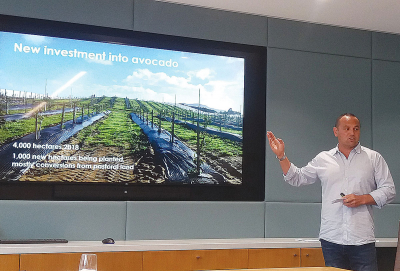 Freshmax’s Jim Tarawa.
An avocado investment underway in the Far North will have a better productivity curve than more southern North Island orchards.
So says Freshmax avocado programme manager Jim Tarawa.
The production season is less acute in the Far North, Tarawa told a MyFarm investor briefing session.
In Bay of Plenty, for instance, biennial production can drop from full production to zero, whereas in the Far North there is a much smaller variation between seasons from the peak.
“We are seeing most new investment in avocados is in the Far North; it is a unique part of New Zealand,” he says.
Aupouri Avocados Ltd Partnership, between Freshmax and MyFarm, holds two properties totalling 32ha on the Aupouri Peninsula in the Far North. MyFarm raised $5.8 million last year from 32 investors to buy the properties. In early March this year, MyFarm raised another $3m from the existing owners and its investor database to buy two more properties for this partnership.
Tarawa says Aupouri, while essentially the soil is sand, has the right mix of environment, heat and plenty of access to water. Most of the planting is going onto a rootstock variety which tolerates disease and water stress. It is all irrigated land.
Because the Far North has a small population base some lateral thinking will be required about how to service the volumes that will come out of the region, he says.
Freshmax will operate the orchards and pack and market the fruit into new and existing markets. The company is a vertically integrated fresh produce business and has one of the largest fresh produce marketing and distribution operations in the Pacific region.
Consolidating the harvest at Whangarei where a good operation already exists is likely, Tarawa says. As the Far North is an early maturing region, labour may be brought up from Whangarei early in the season.
Avocado is a sub-tropical plant which will not grow south of Taupo, except for a few parts of Nelson.
Access to water for avocado growing is an issue worldwide. For instance in Chile it doesn’t rain so growers rely on taking snow melt from the ground; but now they are facing challenges about how much they can take out, says Tarawa. In California volumes are shrinking because of insufficient water, Tarawa says.
“In the Far North where we are growing in sand – I think it has .01% organic matter in it – there is a huge amount of work being done on fertigation (injection of fertilisers into irrigation) and on where you can grow it. You must have the temperature right.”
Tarawa says in New Zealand if water were managed the way the science says it should be there would be plenty of water; the difficulty is getting past the emotion.
Ample water is available in the Far North and water rights are being issued but there is pressure from the rapid development, Tarawa says.
The region has seen a lot of money invested in avocado in the last two years.
“There will be more focus on the management of the volume of water and the monitoring.”
Once harvested, after 30 days avocado fruit quality starts to decline, Tarawa says. So a longer production season may assist in preserving fruit quality for various markets.
NZ has a good reputation for fruit quality based on the Hass variety, he says.
New Zealand avocado growers have received a major boost by securing a collective FernMark Licence for their exports.
As New Zealand's avocado growers struggle to stay afloat after three years of plummeting Hass prices, a new hero emerges in the form of the GEM™ avocado.
An innovative tourism business located in Katikati, is breaking new ground by offering tours of a working avocado orchard.
Kiwi-made avocado milk has been named a winner at the World Food Innovation Awards 2020.
The avocado industry is on alert to understand more about the wood-boring granulate ambrosia beetle found in Auckland, says NZ Avocados chief executive, Jen Scoular.



National’s much-touted free trade deal with India featured in the Rural Issues Debate at Mystery Creek, Hamilton on Wednesday night.

New Zealand's 2026-27 freshwater fishing season has opened, with anglers encouraged to head to rivers and lakes over the coming days as conditions look favourable across much of the country.
Central Otago District Council (CODC) has voted against a plan to spread treated sewage sludge from Cromwell and Alexandra on farmland near Lauder, a decision Federated Farmers says reflects strong opposition from rural residents.
Pāmu has released its FY26 Integrated Annual Report, reporting a Net Operating Profit of $113 million, more than double the $49 million recorded in FY25.
Meat Industry Association data, released alongside the Red Meat Sector conference in Wellington, shows export value climbing across the US, China, UK and Canada.
Applications are set to open for the 2027 Zanda McDonald Award, a trans-Tasman award recognised for identifying and fast-tracking talented young leaders in agriculture and agribusiness.



OPINION: The same mainstream media muppets that brought you Jacindamania in 2017 have been flat out pimping for the Opportunities…
OPINION: Your old mate reckons the atrocious way farmers in the UK are treated by their lords and masters in…