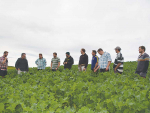
Otago Action Group keen to carry on
The Otago-based Bruce District Action Group is transitioning to a self-funded group now that the Red Meat Profit Partnership (RMPP) has ended.




 increase font size
 Scholarship students attending last year’s HortNZ conference are exactly the kind of young people the newly NZQA-approved programme is trying to encourage into the primary sector.
A programme designed to encourage school students into farming can now be used to gain NCEA credits.
The Red Meat Profit Partnership (RMPP) programme, trialled last year in 10 primary and 16 secondary schools, aims to help students learn more about the sector and promote awareness of the wide range of career opportunities.
Resources including assessments within the programme have now received the New Zealand Qualification Authority (NZQA) Quality Assured Assessment Materials (QAAM) trademark.
Diane Falconer, RMPP’s project manager for people capability, says the resources were developed in response to farmers and the need identified by the Ministry for Primary Industry for more skilled and qualified people to enter the industry; it will start in more schools this year.
RMPP is a Primary Growth Partnership programme that is working to help the red meat sector increase productivity and profitability. Funded by 10 partners – government and private sector – it works with farmers and sector businesses to develop, test and introduce new ideas, technology solutions and ways of working.
“MPI’s 2014 People Powered report showed the red meat sector will need about 11,000 more qualified people by 2025, particularly to achieve its targets of doubling the value of primary industry exports,” says Falconer.
“Also, 75% of farmers agree not enough young people are coming into the industry and there’s a need to address the perception that farming is for secondary school students who are struggling.”
She says agriculture offers exciting and rewarding career opportunities using smart agribusiness technology to meet the growing world demand for NZ’s red meat products. “The sector needs farmers, scientists and agribusiness professionals.”
St Hilda’s Collegiate, Dunedin, was among the trial schools. John Bradfield, head of maths, says the maths department had used the resource in all its level 3 statistics classes, using adapted NCEA level 2 inferences work for level 3 students.
“The trial went well and we will keep using the resource,” says Bradfield. “We are always looking for material like this. There is a lot of depth to the data provided including on stock. We used data such as lamb weights, dates and single and multiple births.”
John McPhail, in charge of agriculture at St Bede’s College, Christchurch, says he plans to use the resources this year.
“They are great for getting ideas for planning units of work,” he says. “I have adapted them slightly to meet my needs but I would assume most teachers would do that.”
The programmes were written by the Core Education professional learning and development organisation and are managed on RMPP’s behalf by NZ Young Farmers.
The primary school resource, for years seven and eight, is designed to fit into the school curriculum and be applicable to different subjects.
Falconer says the resource looks at common stereotypes and aims to debunk the myths and broaden understanding of the many skills farmers need.
“At the end of the programme the children get to visit a farm.”
The secondary school programme includes a cross-curriculum resource for maths and science for years nine and 10.
The RMPP partners are Alliance Group, ANZ, Beef + Lamb NZ, ANZCO Foods, Blue Sky Meats, Greenlea, Progressive, Rabobank, Silver Fern Farms and Ministry for Primary Industries.
The Otago-based Bruce District Action Group is transitioning to a self-funded group now that the Red Meat Profit Partnership (RMPP) has ended.
After seven years, the Red Meat Profit Partnership (RMPP) came to an end on 31 March, yet chair Malcolm Bailey says it's work is "continuous".
Beef + Lamb New Zealand (B+LNZ) has announced changes to the funding approach for Action Groups from 1 April 2021.
A year-long trial has shown that it’s possible to produce a beef patty sustainably across the supply chain in New Zealand.
A new voluntary sustainability and continuous improvement standard developed by the Red Meat Profit Partnership (RMPP) has been piloted by sheep and beef farmers.


Federated Farmers has welcomed new rural policies released by ACT, saying they align closely with its own election priorities.

Rural Contractors NZ says proposed changes to land transport rules for agricultural vehicles are a welcome response by the Government to out of date regulations which have seen members hit with huge fines.
Alliance is calling for final applications for its 2027 Graduate Programme, with applications closing on Sunday 25 October.
Decades piloting planes has ensured vet and farmer David Hayes is focused on safety. So, after a serious accident while welding on farm, he is sharing his experience so others can learn from it.
Canterbury milk processor, Synlait Milk has confirmed Leon Fung as its chief executive officer.
OPINION: Making it easier to collect rainwater and use it to grow crops and livestock is a no brainer.

OPINION: The same mainstream media muppets that brought you Jacindamania in 2017 have been flat out pimping for the Opportunities…
OPINION: Your old mate reckons the atrocious way farmers in the UK are treated by their lords and masters in…




