Kiwi research on infant milk powder colour goes global
A Wintec science student Rehana Ponnal has had research published in the International Dairy Journal late last year, a big accomplishment for an undergraduate student.




 increase font size
 Wintec science student Rehana Ponnal's research has been published in the International Dairy Journal.
A Wintec science student Rehana Ponnal has had research published in the International Dairy Journal late last year, a big accomplishment for an undergraduate student.
Done while Ponnal was on a work placement at Fonterra, the research tested the effectiveness of using a colorimeter to measure the colour of baby milk powder.
Ponnal worked on the research with a number of other scientists, and the journal entry, published in September last year, gives positive results of their findings. As a result of the research, Fonterra is procuring a colorimeter to continue their testing.
“Colour is measured because it’s an important aspect of a product. It’s the first thing you perceive. If milk powder was brown for instance, you wouldn’t buy it,” she says.
Using a colorimeter to measure the colour of the milk powder addresses consistency issues that arise out of using more subjective measures like colour charts.
“Using a colour chart relies on people’s perception of colour. The colorimeter on the other hand gives a reading for a certain colour based on the data of that colour – using this method, something is either that colour, or it’s not. There’s no reliance on individual perception, which can be problematic.”
Ponnal adds that “there are so many things that affect colour reporting, including how long you keep the sample for, even the colour on the charts can be inconsistent for a multitude of reasons.”
Using the colorimeter would not only be more reliable but more efficient as a measurement tool.
“The current process takes longer as several people’s opinions are required to confirm the colour of a sample. With a colorimeter, you just insert the sample and it gives an instant reading. It’s more reliable and more financially beneficial as there’s less time wasted.”
Jackie Wood, a Senior Research Scientist at Fonterra who Ponnal completed her internship with, echoes Poonal’s words.
“At Fonterra we are constantly looking for ways to measure our products in the most reliable and cost-effective way.
“During her internship, Poonal carried out measurements on different infant formulas, milk powders and butter to provide information for these products. She also looked at the cost effectiveness of the using the instrument compared to the current way we access colour of our product.
“It’s an important part of what we do so that we can guarantee the safety and quality of our final products in a time efficient and cost-effective way.”
Wood says working with Ponnal was great, describing her as a very knowledgeable person and worked well independently.
Wood adds that “research carried out by scientific staff at Fonterra is often published in journals, but it is rarer for research carried out by students to be published.”
After completing an Engineering degree in Biomedical Science, Poonal moved to New Zealand in 2017 as an international student to fulfil her passion of studying food science.
Rhys Jones, one of Ponnal’s tutors in her Applied Science degree, says Poonal was their “top graduating Bachelor of Technology student in 2019 and was an excellent student.”
A Wintec science student Rehana Ponnal has had research published in the International Dairy Journal late last year, a big accomplishment for an undergraduate student.
Westpac analyst Michael Gordon says dairy prices may fall slightly over the year as global production bounces back from last year’s depressed levels.
Milk powder exports falling in August have contributed to a 8.7% fall in the monthly value of exports when compared with August 2015, Statistics NZ says.
Major milestones are being knocked off as construction on one of the world's largest dryers races towards completion.
It's been another bad morning for the dairy industry.


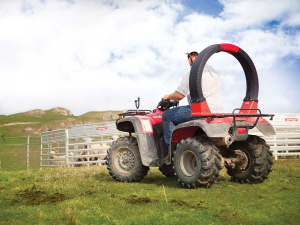
When Northland leather worker Vernon Suckling started making horse saddles 50 years ago, quad bikes and side-by-side vehicles were unheard of.

Alliance Group has confirmed that eligible farmer-shareholders who supply and continue to back the business will receive up to $20 million later this year, following the strategic investment partnership with Dawn Meats.
With a general election under five weeks away, Rural News is asking major political parties about their policies and positions on key issues facing the primary sector. We will run their responses to each question over the next four weeks. The ACT Party and the Greens didn't respond in time.
The red meat sector is in great heart.
Dr Scott Champion, Foundation for Arable Research chief executive, says that everyone in the supply chain had a role to play in driving the sector's long-term success.
Entries opened on Monday, 5 October 2026 for the 2027 New Zealand Dairy Industry Awards (NZDIA), which organisers describe as the nation's biggest celebration of excellence in the dairy sector.




OPINION: The same mainstream media muppets that brought you Jacindamania in 2017 have been flat out pimping for the Opportunities…
OPINION: Your old mate reckons the atrocious way farmers in the UK are treated by their lords and masters in…