Milk Powder Prices Prop Up Farmgate Milk Price
Milk powder prices are keeping farmgate prices up, helping processors offset the dip in milk fat prices.




 increase font size
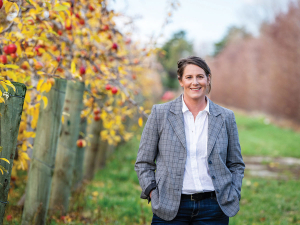
 ANZ chief executive Antonia Watson.
ANZ's chief executive Antonia Watson says agriculture has proven to be “a shining light” for New Zealand’s economy.
The bank released its annual results last week, with the net profit after tax (NPAT) up 4% on last year to $2,369 million for the 12 months to 30 September 2025.
Watson says she is “comfortable” with the result, which saw statutory net profit after tax (NPAT) rise by 21% to $2,532 million.
That increase was largely driven by gains of $163 million from economic hedges, compared to $195 million in the 12 months to 30 September 2024.
“Overall, we were up 4%, which is about the same amount that our lending was up and deposits were up, so we’re comfortable that our growth is matched in our balance sheet,” Watson told Rural News.
She says that there is hope and the conditions are in place for an economic recovery from the Covid-19 pandemic during 2026.
“We’ve got some of the early indicators showing that the economy is growing again,” Watson says.
This includes cuts to the official cash rate (OCR), she adds.
Watson says that while in cities like Wellington and Auckland there has been a reluctance to spend and invest whereas that kind of economic activity appears to be picking up in rural New Zealand.
“Honestly, the agricultural sector is probably the shining light and hopefully, what’s happening in the agricultural sector will flow through to confidence in the cities as well over time.”
Watson says that ANZ is “really comfortable” with where its agricultural clients are at in terms of their debt repayments.
“One of the things that we’ve worked very hard to do over the last 10 years or so is have more of our customers paying principle and interest and therefore their debt is decreasing over time.”
She says a decade ago, 80% of customers were on interest only lending. Prior to the Covid-19 pandemic and subsequent crises that led to rises in interest rates, that number had reached approximately 34%.
“So, that’s a significant number of our agri customers reducing their debt over time, putting themselves in a better condition and also what it meant is that when times got tough and interest rates increased, they could go back on to interest only… it gave them a buffer to go back onto interest only and then gradually we’ve seen them go back to principle and interest as the farmgate prices and things have increased so they’re in pretty good shape overall.”
Milk powder prices are keeping farmgate prices up, helping processors offset the dip in milk fat prices.

Case IH has unveiled its redesigned next generation Puma Series tractors, said to offer improvements in connectivity, operator comfort, fuel efficiency and drivability.
Cameron Reed lives between two worlds.
A milk glut around the world shows no sign of easing, putting downward pressure on farmgate milk prices for the next few months.
The new dairy season is kicking off with plenty of risks to the forecast farmgate price, both upside and downside, says ANZ agricultural economist Matt Dilly.



National’s pledge to introduce 19 new national standards shows the party is serious about getting Wellington out of farming, Federated Farmers says.
The National Party’s policies to make it easier to grow fresh vegetables, secure reliable water and energy and simplify farm planning are practical changes that will give growers the confidence to invest, according to Horticulture New Zealand (HortNZ).
Fonterra Co-operative Group chief financial officer Andrew Murray has resigned to take up a role outside the dairy giant.
A major move is about to get underway to improve the quality and viability of dairy beef and cattle in NZ.
Veterinarians say changes to the code of welfare for dairy cattle provides a positive foundation for improved cattle welfare across the country.
Today, 15 October, is the International Day of Rural Women, which recognises rural women’s contribution to farming, communities and the environment.





OPINION: The same mainstream media muppets that brought you Jacindamania in 2017 have been flat out pimping for the Opportunities…
OPINION: Your old mate reckons the atrocious way farmers in the UK are treated by their lords and masters in…




