DairyNZ Strategy Review: Farmer Feedback Closes 15 Nov
Farmers have until the end of this week to help shape DairyNZ’s future focus.




 increase font size
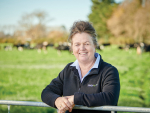
 DairyNZ’s Sally Peel and Morrinsville farmer Aaron Price discuss pasture on his farm.
The hunt is on for great dairy pastures in Waikato and Bay of Plenty.
Entries are open for the pasture renewal persistence competition run by the DairyNZ-led Pasture Improvement Leadership Group. The contest was first held six years ago.
Competition organiser and DairyNZ developer Sally Peel says pasture renewal is a first step to achieving high-performing pastures.
“Improving poor yielding paddocks through good renewal practices can achieve a substantial increase in pasture tonnage and this competition highlights that,” says Peel.
Last year’s winner of the ‘best first year pasture’ category, Aaron Price, says choosing to focus on achieving quality pastures is an easy decision.
“Pasture is our cheapest feed on the farm and it’s important to maximise what we get from it. And regrassing is a significant cost so we have to get the full benefit from it,” says Price , who milks 244 cows near Morrinsville.
Te Pahu dairy farmer Noldy Rust, who won the ‘2015 best pasture more than three years old’ category with an 11-year-old paddock, says the win was humbling.
“I know there are many farmers around with great paddocks. It’s just our good fortune we entered a good competition and won it,” says Rust.
AgResearch senior scientist Dr David Hume, a competition judge, says Rust’s win shows the competition is not only concerned with showing a good pasture on the day, but rather with “a whole combination of things to make a pasture last a number of years”.
“Noldy’s paddock scored particularly well on content of ryegrass and legume, and a good cultivar choice. It was well looked after in winter and summer, had good grazing residuals and good soil fertility.
“Further, Noldy was familiar with new cultivar choices and was using AR37 endophyte on parts of the farm, where black beetle had been a problem.”
http://www.dairynz.co.nz/feed/pasture-renewal/pasture-persistence-competition
Farmers have until the end of this week to help shape DairyNZ’s future focus.
The New Zealand dairy sector set a record in the 2025/26 season, producing more than two billion kilograms of milksolids for the first time.
Students will be able to study Agriculture and Horticultural Science from Year 11, creating a clear pathway into Years 12 and 13 and future careers in New Zealand’s primary industries, Education Minister Erica Stanford says.
OPINION: New Zealand dairy is delivering. In the year to June, dairy exports earned a record $28.8 billion for New Zealand. They were part of a record $65.2 billion earned by our wider food and fibre sector.
Today, 15 October, is the International Day of Rural Women, which recognises rural women’s contribution to farming, communities and the environment.


During the nesting season, from September to December, industrious starlings can quickly build nests in the darker areas behind tractor and vehicle, usually close to hot engines, typically resulting in localised damage or in some cases complete write-offs.
The meat processing industry is much more collegial than it was in the past and is now more focused on common goals.
With the last couple of months having seen some potential tractor purchases put on hold with the impending election and continued input cost rises, year-to-date figures, ending September, has seen deliveries up around 5% over the same period in 2025, with a total of 2026 units.
Beef+Lamb New Zealand is calling for nominations for director roles in the Northern South Island and Northern North Island electoral districts.
Fonterra chief executive, Richard Allen says being resilient has helped the dairy industry overcome extreme volatility in recent years.
The head of the Ministry for Primary Industries (MPI) trade and international relations group says New Zealand is well-positioned to secure trade access and compete internationally as the world becomes more complicated, demanding and uncertain.

OPINION: It seems Canterbury processor Synlait is still in the doldrums.
OPINION: Get offside with New Zealand First leader Winston Peters at your own peril.