Getting the biggest bang for your buck out of fertiliser while protecting economic and environmental bottom lines is a key goal for farmers.
As the soil starts warming over the next few weeks, farmers will be preparing to fertilise their paddocks. Finding the balance is critical for farmers and requires advice from fertiliser reps and consultants.
That’s because healthy soils are a balance of biological, physical and chemical properties, and are a dynamic mixture of minerals, organic residues and living micro and macro organisms, all of which support farm production and provide various eco-system services.
As there are risks when applying fertiliser, and strategies to avoid them, I recommend all farmers have a nutrient budget and management plans for their properties and discuss their situation with their fertiliser rep. It’s also a requirement of our current regional plan to have such a budget and plan if nitrogen (N) use exceeds 60kg/ha per year.
Nutrient budgeting is widely accepted as the appropriate first step in managing nutrient use and it’s also the preferred tool for evaluating the environmental impact of farm management practices.
Overseer, a computer decision-support model, can be used to advise and support nutrient management decisions and, more recently, green-house gas emissions.
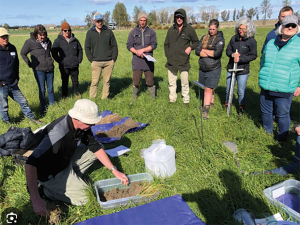
Soil quality monitoring from around the Waikato points to high fertility and compaction as the major issues on dairy and some drystock farms.
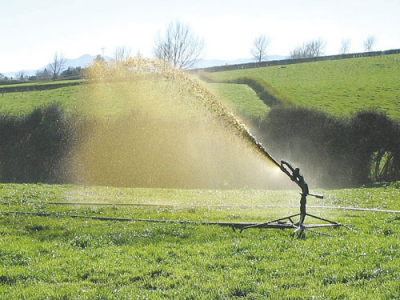
Nitrate leaching is another more widely talked about issue. Plants need N for healthy leaf growth, but N is an extremely mobile nutrient. If more nitrogenous fertiliser is applied than plants can take up, most of the unused nitrogen ends up leaching through the soil into groundwater. Sometimes N will also be lost to waterways as run-off and some is always released back into the air as gas.
The amount of N leaching from pastures can be reduced by:
- timing fertiliser application to avoid periods when plant uptake of N will be low, such as when soils are saturated, during heavy rain, colder periods and times of low soil temperatures
- applying N fertiliser in split dressings (as many split doses as possible)
- irrigating farm dairy effluent to a large area
- adjusting fertiliser policy for effluent irrigated areas to account for the nutrient value of effluent
- using fenced wetlands and well-managed open drains as nutrient traps.
The nutrient phosphorus behaves very differently from N because it binds with the soil and only dissolves slowly in water over time. This means it doesn’t readily leach to groundwater. But it can damage the health of waterways through soil erosion and surface run-off into water.
Farmers can reduce the amount of phosphorus run-off by keeping Olsen P to optimum agronomic levels. Other tips include:
- following the NZ Fertiliser Manufacturers’ Research Association Code of Practice for Nutrient Management
- applying fertiliser when the grass is in a growing phase
- leaving a grassed buffer strip between paddock and waterway; the strip filters the phosphorus before the run off reaches the water
- controlling run-off from tracks, races, feed and stand-off pads.
So, a clear assessment of fertiliser requirements will improve economic returns from pasture and help avoid contamination of ground and surface water with nutrients, particularly nitrogen and phosphorus.
With Healthy Rivers/Wai Ora: Waikato Regional Plan Change 1 around the corner, there is increasing pressure on farmers to improve their nutrient management.
• Bala Tikkisetty is a sustainable agriculture advisor at Waikato Regional Council. Contact him on This email address is being protected from spambots. You need JavaScript enabled to view it. or 0800 800 401.