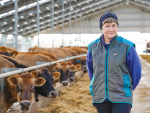
Breeding the Ultimate Robot-Ready Jersey Herd
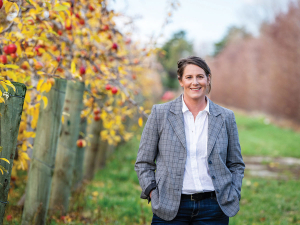
In the beautiful, scenic expanse of Invercargill, Joanne (Jo) Crack of Southern Star Farms is redefining what it means to run a modern, self-sufficient dairy operation.




 increase font size
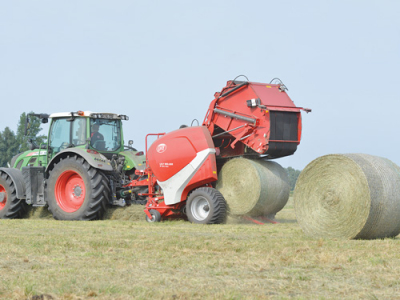 Lely Welger RP160 V variable baler.
Lely's newest variable-chamber round baler certainly stands out from the crowd.
The Lely Welger RP 160 V variable baler is a guarantee of a nicely shaped, high density bale, the company says.
With a newly designed bale chamber using four endless belts, a five-tinebar camless pick-up of 2.25 m, and a 13 knife chopping unit, the designers have clearly been busy.
The bale geometry of the Welger RP 160 V has changed dramatically, with the bale formation enhanced from the start, with rollers positioned further into the chamber, ensuring better contact and bale rotation, which results in a high density bale with a good shape. As the bale grows, the tailgate moves downwards, forcing the bale to move in a rearward-direction, so reducing the pressure on the feed-intake area of the baler.
Four endless belts made of layers of synthetic and rubber offer optimum grip on the crop and can exert an impressive pressure on the bale. The belt layers are securely manufactured with a large overlap and are independent of each other; they carry a 20,000 bale warranty, although endurance testing has seen items last beyond 50,000 bales with minimum stretch.
All Welger variable balers have the constant pressure system (CPS) that increases pressure when the surface of the bale grows, so delivering consistent density throughout the bale. Hydraulics work with a mechanical spring system, building pressure until the pre-set density is achieved. The unique design of the belt tension system and the position of the CPS rams ensure the tension on the belts increases proportionally to bale circumference.
The Varionet net wrapping system ensures net wrap is evenly applied across the bale, eliminating unwanted air pockets before wrapping and helping to improve feed quality.
Replacement net rolls are easily loaded from ground level, saving time and effort for the operator, and easily opened side doors allow quick access to a second storage location and increased access to the machine for maintenance and inspection.
Central greasing banks and an automatic chain lubrication system, using foam pads as opposed to traditional brush systems, means all drive chains are constantly lubricated, guaranteeing a longer life.
The E-link Pro terminal is standard on the RP 160 V models for New Zealand. The large touch screen display provides all the relevant information required to ensure efficient baling and data analysis. The system is ISObus compatible, so any tractor can be easily connected, allowing you to use its own terminal.
In the beautiful, scenic expanse of Invercargill, Joanne (Jo) Crack of Southern Star Farms is redefining what it means to run a modern, self-sufficient dairy operation.
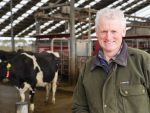
In Dacre, near Invercargill in New Zealand’s South Island, Bruce Dinnington is running a dairy operation unlike any other.
Getting calves away to a strong start means attention to detail from day one, so the Lely Calm, an automatic drinking system for calves, prepares and feeds rations at the right temperature and is designed to ensure calves receive smaller, more frequent portions throughout the day.
The first weeks of a calf's life quietly shape the future of the entire herd.
Since its decision to concentrate on milk harvesting and animal husbandry, resulting in the selling of its agricultural machinery brands and factories, Lely’s focus seems to be paying off with a growing business.


National’s pledge to introduce 19 new national standards shows the party is serious about getting Wellington out of farming, Federated Farmers says.
The National Party’s policies to make it easier to grow fresh vegetables, secure reliable water and energy and simplify farm planning are practical changes that will give growers the confidence to invest, according to Horticulture New Zealand (HortNZ).
Fonterra Co-operative Group chief financial officer Andrew Murray has resigned to take up a role outside the dairy giant.
A major move is about to get underway to improve the quality and viability of dairy beef and cattle in NZ.
Veterinarians say changes to the code of welfare for dairy cattle provides a positive foundation for improved cattle welfare across the country.
Today, 15 October, is the International Day of Rural Women, which recognises rural women’s contribution to farming, communities and the environment.




OPINION: It seems Canterbury processor Synlait is still in the doldrums.
OPINION: Get offside with New Zealand First leader Winston Peters at your own peril.




