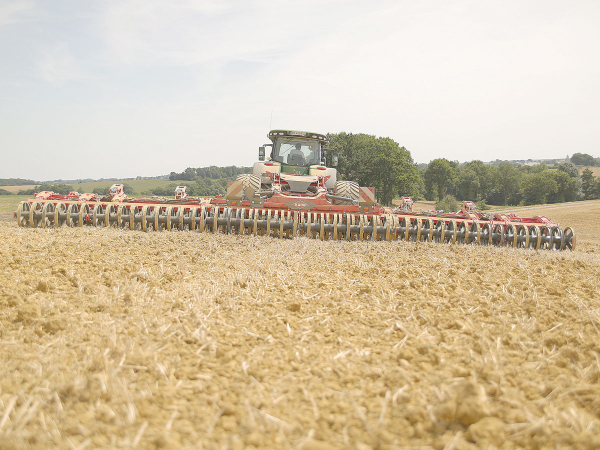
Kuhn has extended its range of independent disc stubble cultivators with the addition of the high capacity Optimer L Series.
Available in 9 and 12 metre working widths, Optimer L is designed for high quality shallow cultivation at operating speeds of 13 to 18 km/h. With a working depth range from 3 to 10cm, it is sufficiently versatile to fulfil a range of roles including enhanced crop residue management, stale seedbed creation and fine seedbed preparation.
The layout sees two rows of 510mm diameter discs operate set at 16˚ from horizontal and 6˚ from vertical for optimum tilth creation. Discs, available with small notches (for shallow cultivation) or large notches (for deeper soil penetration), are mounted individually on support arms, using four integral polyurethane elastomeric blocks to provide protection and depth control.
Each disc uses a single maintenance-free bearing, which combines with an underframe clearance of 55cm, to ensure a clear residue flow through the machine, prevents disruptions due to blockages.
Working depth is hydraulically assisted, allowing easy and accurate adjustment that, once set, is maintained across the full width of the machine via hydraulically controlled pressure in the extension cylinders – the Kuhn’s Steady Control system.
At the rear, the machine is fitted with the Double-U self-cleaning and anti-clogging roller, designed to provide optimum soil consolidation. By turning on the roller at the headlands, the machine maintains stability and minimises any risk of soil compaction in these areas.
For transport, machines fold to 3m width and 4m high, using a four-step process, activated by a mode switch on the in-cab control panel.
www.kuhn.co.nz