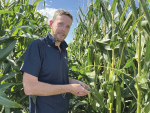
Fall Armyworm in NZ Maize: Four Years of Research
Four years since it was first detected in New Zealand, researchers and growers now know much more about management of maize pest fall armyworm (FAW).




 increase font size
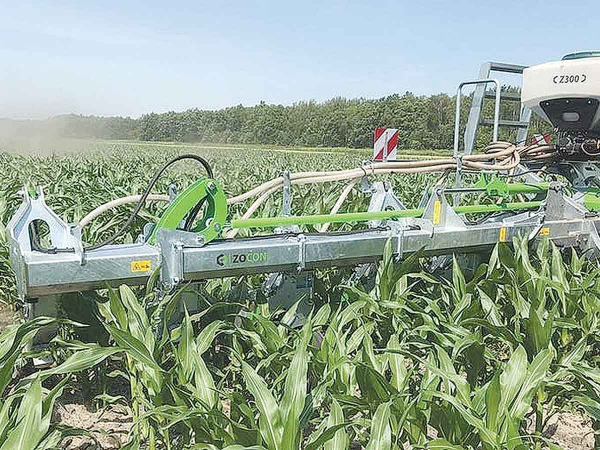 Zocon Greenseeder
A Dutch-built drill for establishing catch crops is said to offer a quicker and more effective method of establishing grass under maize.
The drill is gaining momentum in the UK and is likely to find favour with forward-thinking growers in New Zealand.
The Zocon Greenseeder was released following the introduction of regulations in the Netherlands that makes it mandatory to establish a green cover crop by October 1st and forbids leaving harvested maize ground bare over the winter period.
In the UK, water authorities are taking notice of the environmental impact of growing maize, for either forage or feeding anaerobic digestion plants, particularly in nitrate leaching. Several are now offering financial support to reduce problems, while some dairy companies are beginning to stipulate green cover as part of their farm assurance schemes.
The GreenSeeder features a linkage mounted, galvanised steel frame that offers 850mm of ground clearance, meaning grass can be sown later in the season, so extending the working window. A rigid main beam is fitted with hinged arms that in turn carry the soil engaging elements. At the headland, a hydraulic lift system for the trailing tine harrows lifts them into the air to prevent crop damage. This “high-lift” system allows the use of the machine in taller crops, with operating speeds of up to 12 km/h.
Working height is controlled by four support wheels, while the seed is distributed through feeder pipes onto spreader plates that offer a full spread up to the base of the maize plants. Harrow tines measuring 10mm, with five pressure settings, ensure good seed to soil contact.
Four years since it was first detected in New Zealand, researchers and growers now know much more about management of maize pest fall armyworm (FAW).
As spring calving cows head into dry-off, the priority shifts to one thing: setting cows up to calve at the target body condition score (BCS).
Early December marks a key transition for many dairy farmers, as weaned replacement heifers head off-farm to grazing.
I recently had the pleasure of attending an AgFirst event in Hamilton where the results of the 2024-25 Waikato-Bay of Plenty Dairy Financial Survey were shared. Based on a 136ha farm milking 379 cows, average farm profit before tax was $405,892, an incredible 286% increase on the 23-24 season.
Over the past few months, I’ve had the privilege of speaking with many farmers at events and one-on-one.


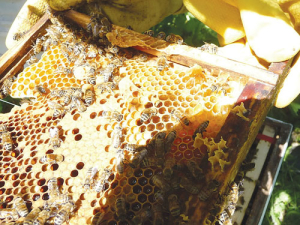
New Plymouth-based Manuka honey exporter Egmont Honey has completed its acquisition of Taihape beekeeping business Tweeddale's Honey, with settlement finalised on Friday, 18 September.

Westpac NZ is calling on farmers and growers to start preparing now for the possibility of a dry summer, as likely El Niño conditions raise the risk of drought across parts of the country.
Fonterra Co-operative Group has confirmed the independently assessed candidates standing for election to its board in 2026.
Fonterra has revised its Farmgate Milk Price forecast for the 2026/27 season, lifting the midpoint and narrowing the range on the back of improving global dairy commodity prices.
New Zealand's citrus growers were challenged to build their future on the value embedded in their fruit rather than the volume they produce, at Citrus New Zealand's annual gathering in Gisborne on 17 September.
Leading John Deere technicians and apprentices from New Zealand and Australians were recognised at the recent sixth annual JD Technician of the Year Awards, held in Brisbane.


OPINION: It seems Canterbury processor Synlait is still in the doldrums.
OPINION: Get offside with New Zealand First leader Winston Peters at your own peril.