John Deere Secures Record 20-Harvester Deal
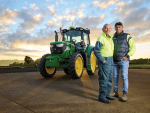
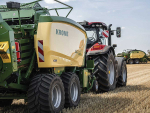
The old saying is ‘go big or go home’, which appears to be something that German contracting business Kohl Harvest of Saxony-Anhalt in Bavaria has done with a record order for John Deere.
John Deere has introduced a new line-up of rotary cutters in the form of the E, M and R series, with a new deck and cutting chamber design.
Varied working widths and machine configurations allow users to deal with grass, pasture, crop residues and roadsides; they’re good for farm and commercial work.
Much of the redesign is to get better cutting performance: a reshaped chamber design increases volume, better airflow around the deck improves the quality of cut and material distribution under the deck, and less material accumulates above.
At the front, a suspended front mount helps improve stability by isolating movements between the tractor and the implement and vice versa.
New torsional rear suspension is optional for the M-series but is part of the base package of the high-spec R-series. This configuration helps machine stability and gives a more consistent cutting height.
E-series machines have a 75hp rated gearbox and Category 4 driveline. The 100hp/Category 5 is the base for M-series, with the option of an upgrade to 125hp/Category 6. All R-series machines are equipped with the 125hp/Category 6 configuration to achieve greater capacity, improved durability and increased output.
Working widths: first, the new 3.6m (12-foot) cut E12, then the 4.5m (15-foot) cut E15; in the M-series the choice is the 4.5m M15 or the 6.1m (20-foot) cut M20; the top-of-the-range R-series contains the 3.5m R10, 3.6m R15 and the 6.1m R20.
New Zealand dairy farmers are set to be the first in the world to receive access to a new digital physical milk pricing tool that enables them to fix the price for their physical milk.
State farmer Pāmu is opening its farm gates this summer in an effort to give the rural sector the opportunity to see how large-scale, multi-system farming is delivering productivity and profitability across New Zealand.
A five-year study has found that the cost of reducing emissions without technology may be significant and unsustainable for Northland dairy farmers.
DairyNZ says Waikato farmers need certainty on Plan Change 1, but they say that certainty must be matched with practical, workable rules and a clear transition that doesn't get ahead of the new resource management system currently under review.
While the Government has moved quickly to make commercial hauliers' lot easier during the current fuel crisis, they appear to be stuck in the creep box when it comes to the agricultural industry.
Waikato farmers have been told that the Government’s new planning system legislation and the region’s Plan Change 1 (PC1) “won’t mesh together very well”.
OPINION: No one messes around with Winston Peters, more so in a general election year.
OPINION: Staying on Federated Farmers, this week's annual general meeting in Auckland is shaping up to be an interesting one.