Importer: Fertiliser Security Policy Must Include All Players
An independent importer says National’s fertiliser security policy will only work if protects all players.




 increase font size
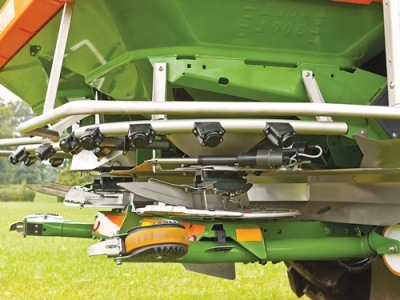 Amazone fertiliser spreaders.
Amazone feriliser spreaders, well respected for many years, have won their maker a Machine of the Year Award at the recent Agritechnica show.
The Amazone ZA-TS featured the new Argus Twin lateral technology where each disc uses radar sensors above each unit to monitor the spread pattern, automatically adjusting the delivery if any deviation is detected from the required setting.
Mounted rigidly and with no moving parts, the system is said to be robust and maintenance-free in what is typically a harsh environment. The system will compensate for changes in spread pattern that might be caused by fertiliser quality, start-off speeds or braking, travelling on slopes, or even when spreader vanes are worn.
The technology will operate during border spreading or section control and aims to ensure the most effective use of the fertilisers and easy operation.
Argus Twin can be optioned on all mechanically or hydraulically driven machines in the ZA-TS range and is said to complement other automated technologies such as auto-calibration and tilt-sensing, and inasmuch gives the operator the ability to set the rate and drive off.
The automated systems then check actual delivery rate against the set target. Tilt sensing detects any deviation from the centre of gravity and electric shutter control ensures an even three dimensional spread regardless of terrain.
An independent importer says National’s fertiliser security policy will only work if protects all players.

Vetekina Pau'u is the first Tongan to win the William Gearish Memorial prize and sadly she will also be the last recipient.
Combine premium New Zealand products, blend in a family ritual and what do you get? A world-class functional drink.
Applications are set to open for the 2027 Zanda McDonald Award, a trans-Tasman award recognised for identifying and fast-tracking talented young leaders in agriculture and agribusiness.
The Ballance Farm Environment Awards are coming to the West Coast of the South Island.

Halter has launched Mav, an AI farming assistant that lets dairy farmers ask questions about their herd and pasture and get answers drawn from the data the company’s collars already collect.

OPINION: At first glance it appears that Father Christmas has delivered the rural sector good tidings, with most pundits predicting the return of the centre-right coalition.
For 15 years, Glenda Rees has travelled from Gore to Awarua, often several times a week, to keep watch over one of the country’s rarest birds.
With some farmers opposing a government-industry partnership set up to develop methane reducing products, one NZ company claims that it already has a product on the market.
During the nesting season, from September to December, industrious starlings can quickly build nests in the darker areas behind tractor and vehicle, usually close to hot engines, typically resulting in localised damage or in some cases complete write-offs.
The meat processing industry is much more collegial than it was in the past and is now more focused on common goals.

OPINION: It seems Canterbury processor Synlait is still in the doldrums.
OPINION: Get offside with New Zealand First leader Winston Peters at your own peril.