
Leon Fung confirmed as Synlait CEO
Canterbury milk processor, Synlait Milk has confirmed Leon Fung as its chief executive officer.




 increase font size
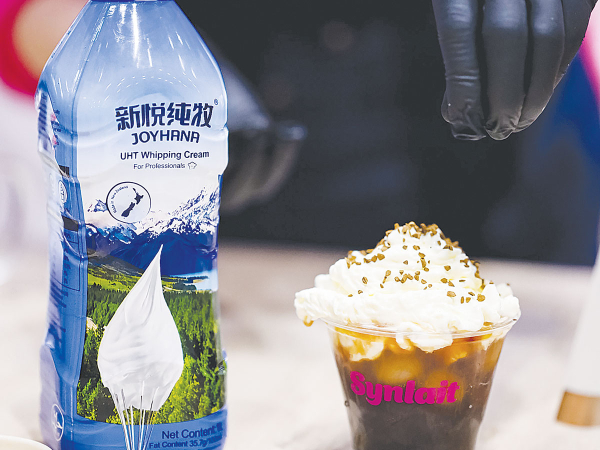 Synalit hopes that sales of Joyhana branded cream in China will bring the company joy.
Canterbury processor Synlait is eyeing a slice of China's lucrative cream market.
Late last year, the company launched its Joyhana branded UHT cream product with customer Savencia Group, the 12th largest dairy company globally.
Within five years it hopes to be selling 22,000 metric tonnes of cream in China and making a gross margin of $24 million.
Synlait chief executive Grant Watson told Dairy News that the Synlait and Savencia relationship is very complementary.
"They are responsible for distribution, branding, and marketing and Synlait is responsible for high-performance product development and manufacturing," says Watson.
"Savencia's local division, Sinodis, sells it to our Chinese hospitality partners who turn it into finished products for out-of-home consumption at bakeries, cafes, beverage chains and restaurants for example.
"This is a high growth market of around 250,000MT overall, with market segments, such as bakeries, growing at 10% year on year. That gives a good idea of the opportunity available to us.
"Synlait's ambition is for sales volumes of 22,000MT and a gross margin of $24 million in FY28 as we ramp up volumes across FY24 to cater to increased demand."
Watson says Joyhana has been extremely well received in China.
"We were thrilled to see our Joyhana UHT Whipping Cream win the 'New Product Innovation Award' at the prestigious China International Bakery Exhibition in May this year," he says.
When it comes to exporting cream to China, no one does it better than New Zealand dairy companies. NZ accounts for 58% of all China's cream imports. For comparison, Australia accounts for just 2% of China's cream imports. In 2022, China needed 250,000 metric tonnes of cream.
NZ cream is popular in a growing food service sector. China's bakery sector is growing at nearly 10% and the beverage sector at 13.5%. Fonterra and Westland also export cream to China.
Exports to the Greater China region have also benefitted from the New Zealand-China Free Trade Agreement. Since 1 January 2022, products such as liquid milk and cream, butter, anhydrous milk-fat, and cheeses have been entitled to duty free access to China without volume restrictions. From 1 January 2024, this will also be extended to whole milk powder, and skim milk powder, at which point all dairy exports from New Zealand to China will be entitled to duty free access.
Canterbury milk processor, Synlait Milk has confirmed Leon Fung as its chief executive officer.
Waikato milk processor Tatua has again declared a record milk payout to farmer shareholders, leaving other processors in the dust.
Synlait has swung to second-half profit as operations stabilise, but the dairy processor still posted a $75.4m annual loss.
OPINION: It seems Canterbury processor Synlait is still in the doldrums.
Speculation of a possible joint move by Fonterra and a2 Milk to buy Synlait raises a much bigger strategic question, says agribusiness expert Dr Nic Lees.


Federated Farmers has welcomed new rural policies released by ACT, saying they align closely with its own election priorities.

Rural Contractors NZ says proposed changes to land transport rules for agricultural vehicles are a welcome response by the Government to out of date regulations which have seen members hit with huge fines.
Alliance is calling for final applications for its 2027 Graduate Programme, with applications closing on Sunday 25 October.
Decades piloting planes has ensured vet and farmer David Hayes is focused on safety. So, after a serious accident while welding on farm, he is sharing his experience so others can learn from it.
Canterbury milk processor, Synlait Milk has confirmed Leon Fung as its chief executive officer.
OPINION: Making it easier to collect rainwater and use it to grow crops and livestock is a no brainer.

OPINION: It seems Canterbury processor Synlait is still in the doldrums.
OPINION: Get offside with New Zealand First leader Winston Peters at your own peril.




