Resilient Global Dairy Industry Overcoming Volatility
Fonterra chief executive, Richard Allen says being resilient has helped the dairy industry overcome extreme volatility in recent years.




 increase font size
 Andrew Hoggard.
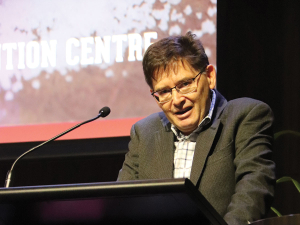
As well as laying out its new strategy, Fonterra should make clearer how it got into this trouble, says Federated Farmers national vice-president and dairy farmer Andrew Hoggard.
“I’d like to see them be a bit open and upfront about what has gone wrong, how it was wrong and what were the mistakes,” he told Dairy News.
He accepts he may be accused of living in the past but “if you don’t learn from history you are bound to repeat its mistakes”.
“So let’s make sure we know what the hell went wrong so we don’t repeat it.”
An example is the bonuses to former chief executive Theo Spierings for “f***ing the company up to be honest”. “How the hell you pay someone a bonus for the sort of mess created is beyond me.”
He hopes all those types of things have been tidied up and “we never see something like that again”.
“There is definitely a sense of frustration at what has been. At the same time I have picked up a degree of eagerness to move forward. Just as long as the new direction or strategy is clearly articulated to us.”
He has heard it said the focus will be more on New Zealand milk but nothing has yet been put in concrete about what the strategy “is and what it looks like”.
Dairy farmers hope that will be clearly articulated in the September update.
“I have picked up that people are more positive about the direction but they are still pretty pissed off about what has been.”
He doesn’t think Fonterra farmers will jump ship over the lack of dividend.
“We still have a good milk price. If you are upset that you are not going to get a dividend and you want to leave and supply someone else, nobody else will give you a dividend anyway. They will only give you a milk price very similar to Fonterra’s.
“There might be a few people who get upset by it and decide that is the way to go but for me the logic train doesn’t quite link up.”
Fonterra chief executive, Richard Allen says being resilient has helped the dairy industry overcome extreme volatility in recent years.

Northland farmer Greg Collins has taken over as chair of the Fonterra Co-operative Council.
Farmers will wait it out like the rest of the country as the composition of the incoming government remains up in the air.
Fonterra’s 2026 financial year was a year of delivery, with record volumes of milk collected, processed and shipped by the co-op.
Dairy farmers, still holding onto their Fonterra shares despite switching milk supply elsewhere or exiting the industry, now face a stricter share sell-down requirement.

During the nesting season, from September to December, industrious starlings can quickly build nests in the darker areas behind tractor and vehicle, usually close to hot engines, typically resulting in localised damage or in some cases complete write-offs.
The meat processing industry is much more collegial than it was in the past and is now more focused on common goals.
With the last couple of months having seen some potential tractor purchases put on hold with the impending election and continued input cost rises, year-to-date figures, ending September, has seen deliveries up around 5% over the same period in 2025, with a total of 2026 units.
Beef+Lamb New Zealand is calling for nominations for director roles in the Northern South Island and Northern North Island electoral districts.
Fonterra chief executive, Richard Allen says being resilient has helped the dairy industry overcome extreme volatility in recent years.
The head of the Ministry for Primary Industries (MPI) trade and international relations group says New Zealand is well-positioned to secure trade access and compete internationally as the world becomes more complicated, demanding and uncertain.
OPINION: It seems Canterbury processor Synlait is still in the doldrums.
OPINION: Get offside with New Zealand First leader Winston Peters at your own peril.