Synlait FY26 Result: $75.4m Loss, Second-Half Profit
Synlait has swung to second-half profit as operations stabilise, but the dairy processor still posted a $75.4m annual loss.




 increase font size
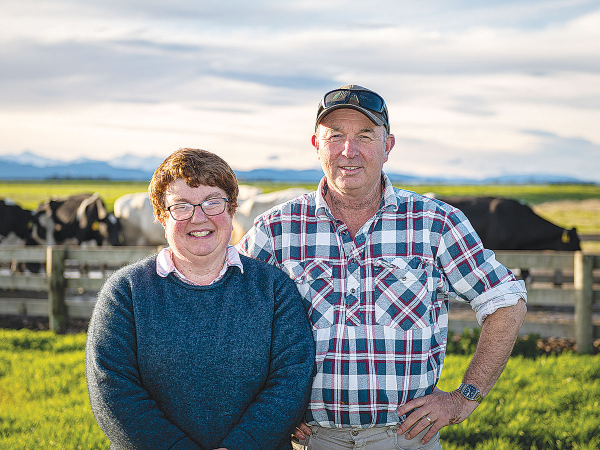 Bruce and Susan Turpie, Canterbury.
Canterbury farmers Bruce and Susan Turpie love doing things differently on their 500ha farm.
They year-round milk 1,550 cows, mostly Holstein Friesian with a few Montbelliardes, and their nine-year-old dairy business, Kolmar Dairies Ltd supplies Synlait.
At the recent Synlait Dairy Honours Awards they picked up the 'Doing Milk Differently Award', which recognises farmers who demonstrate "Kiwi ingenuity" for solving a problem and pursuing a new opportunity.
The judges noted the Turpies' successful and innovative approach to farming.
Over the last six years, Bruce and his team moved towards calving four times a year to milk year-round. They have an intensive operation with two separate herds split between barn and paddock and rotated each 12-hour period. This system allows them to maximise feed and effectively get cows off paddock in winter, resulting in high production and strong pasture health and resilience.
Additionally, with a herd of over 1,550 cows, Bruce and his team have achieved zero bobby calves, an incredible achievement, according to the judges.
This has involved the use of Wagyu beef genetics and set semen selection, meaning non-replacement calvexs are able to be raised and sold into the beef industry.
Another notable aspect of this operation is the high staff numbers. Bruce has 15 team members and high staff retention. The judges noted that this can be attributed to an inclusive, positive culture.
"Aspects such as staff housing in Methven ensure employees are a part of the community, and cross-training opportunities mean staff are further developed in skills beyond their core roles.
"Kolmar Dairies Ltd is truly the epitome of what it means to Do Milk Differently."
Bruce Turpie told Dairy News that they were "pretty chuffed" with the award.
"It's good to get recognition for the work we're doing. We do things differently. We have a big amount of winter milk. We don't always take the easy path but we do things the way we want to do them and it works for us," he says.
Like most dairy farmers, the Turpies face challenges and like most farmers, labour shortages top of the list.
With the borders closed, Bruce says they just can't attract new juniors.
"We have enough senior staff but it's harder to get juniors.
"In the past we'd get them from overseas and then they'd progress up from there, but we just can't get the juniors here in New Zealand."
When it comes to staff management, Bruce believes farmers just have to be proactive.
"And we try really hard to make sure staff are happy and want to stay with us."
Sustainability is also a priority for the Turpies.
They have a Herd Home and 50% of the herd utilise it all year round.
"It reduces our nitrate issues and means we can control it as much as possible," says Bruce.
The farm is part of Synlait's 'Lead with Pride' initiative and meets some pretty stringent sustainability measures as a baseline.
Just A Blip
Synlait is going through a challenging period but the Turpies have full confidence in the company.
Bruce Turpie says they are very happy supplying milk to the listed milk processor.
"They've been through some tough times recently but you can't blame them for that," he says. "They had a big expansion with liquid milk and Pokeno and maybe went a bit big, a bit quick but we're all guilty of that as business owners sometimes.
"And then Covid happened and there was a bit of pressure on a2, but they'll come out the other side and we see it as just a one-year blip. They'll be leaner and stronger for it."
Synlait has swung to second-half profit as operations stabilise, but the dairy processor still posted a $75.4m annual loss.
Speculation of a possible joint move by Fonterra and a2 Milk to buy Synlait raises a much bigger strategic question, says agribusiness expert Dr Nic Lees.
A revolving door of chief executives at milk processor Synlait is a warning sign, says Lincon University senior lecturer in agribusiness Nic Lees.
Troubled milk processor Synlait has lost its third chief executive in five years.


The Royal New Zealand College of General Practitioners (the College) and Hauora Taiwhenua Rural Health Network are calling for investment in a proposed new training pathway for rural GPs, warning that many rural practices are struggling to recruit while a large share of the existing workforce nears retirement.
Federated Farmers has called on Central Otago District Council (CODC) to drop or vote down a plan to truck sludge from Alexandra and Cromwell to farmland near Lauder, warning it would compound an "outrageous" situation created by a separate council's decision weeks earlier.
Synlait has swung to second-half profit as operations stabilise, but the dairy processor still posted a $75.4m annual loss.
LIC shareholders have elected a new North Island representative to the co-operative's Board, along with five representatives to its Shareholder Reference Group (SRG), following the company's Annual Meeting held in Invercargill.
Farmers across parts of Southland and South Otago are continuing to deal with difficult conditions after a prolonged run of wet weather, with pressure building around feed supply, stock management, pasture damage, farm infrastructure and everyday workloads.
Federated Farmers says it welcomes Labour's commitment to reviewing the Sharemilking Agreements Act, calling on other major parties to do the same.
OPINION: It seems Canterbury processor Synlait is still in the doldrums.
OPINION: Get offside with New Zealand First leader Winston Peters at your own peril.