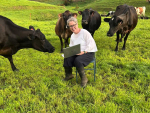
International Day of Rural Women: Two DairyNZ Farmers’ Stories
Today, 15 October, is the International Day of Rural Women, which recognises rural women’s contribution to farming, communities and the environment.




 increase font size
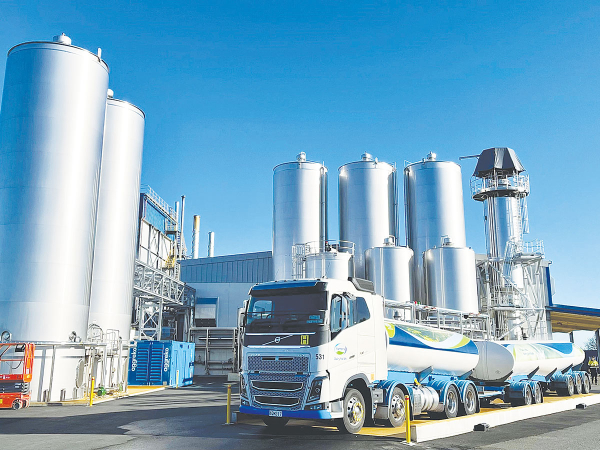 Fonterra will pay out $800 million today as capital return to shareholders.
A day of bad news for Fonterra farmers is ending on a high note – the co-operative is paying out $800 million today as capital return to shareholders.
In a statement to NZX, Fonterra confirmed that the capital return was implemented yesterday by way of a court-approved scheme of arrangement under Part 15 of the Companies Act 1993 (Scheme).
“Payments to shareholders are being processed today in accordance with the terms of the Scheme,” the co-op says.
The capital return has been funded by sale of co-op assets including its successful Soprole business in Chile.
Fonterra purchased one out of every six shares held by each shareholder for $3/share repurchased. This is equivalent to 50 cents for each of the six shares.
At the same time, one share held by each shareholder, which is not bought by Fonterra, will be subdivided so that each shareholder will end up holding the same total number of shares as they held before the repurchase.
The capital return provides some relief to Fonterra farmers, who this morning faced a second cut to the forecast milk price in two weeks.
In May Fonterra announced an opening 2023/24 season forecast Farmgate Milk Price range of $7.25 to $8.75/kgMS, with a midpoint of $8/kgMS.
Two weeks ago, it was forced to slash the mid-point by $1 to $7/kgMS. This morning it shaved another 25c of the mid-point.
The co-op says a slump in global dairy prices has forced the revision of the forecast milk price.
On Global Dairy Trade, dairy prices are now at their lowest point since late 2018, while WMP prices are at their lowest point since this time in 2016.
The Government has also come out today with its emissions pricing plan for the agriculture and the proposals have been roundly rejected by farmers.
The Government has shifted farm-level emissions reporting requirements into quarter 4 of 2024; emissions pricing won’t start until two years from now in quarter 4 of 2025.
Work will also get underway to allow scientifically validated forms of on-farm sequestration into the ETS, which can help reduce the cost to farmers.
DairyNZ says the agriculture emissions pricing plan released by the Government today is thoughtlessly timed and lacks the detail dairy farming needs for a viable solution.
DairyNZ chair Jim van der Poel says today’s outcome comes after a significant delay and does not reflect the progress the dairy sector has been seeking.
Today, 15 October, is the International Day of Rural Women, which recognises rural women’s contribution to farming, communities and the environment.

Four candidates have been confirmed for two director positions on Fonterra’s board.
A record farmgate milk price and strong global demand is laying the foundation for continued growth of organic dairy farming in New Zealand.
Waikato milk processor Tatua has again declared a record milk payout to farmer shareholders, leaving other processors in the dust.
Fonterra has unveiled its annual results for the 2026 financial year, posting $27 billion in revenue and close to $20 billion returned to New Zealand farmer owners and unit holders.


A major move is about to get underway to improve the quality and viability of dairy beef and cattle in NZ.
Veterinarians say changes to the code of welfare for dairy cattle provides a positive foundation for improved cattle welfare across the country.
Today, 15 October, is the International Day of Rural Women, which recognises rural women’s contribution to farming, communities and the environment.
Global dairy giant Lactalis has integrated its Australian operations with the Mainland Dairy consumer business it acquired from Fonterra earlier this year.
After almost two decades of sharemilking, saving and building equity, Aaron and Marcia Flay this year realised their long-held dream of settling on their first dairy farm.
Good medium to long term prospects for NZ beef, especially in the US, has heighted the focus on various initiatives to capitalise on this situation.

OPINION: It seems Canterbury processor Synlait is still in the doldrums.
OPINION: Get offside with New Zealand First leader Winston Peters at your own peril.




