BCS Targets: Why Body Condition Score Matters at Calving
Body Condition Score (BCS) is a critical element in managing the health and reproduction of the dairy herd.




 increase font size
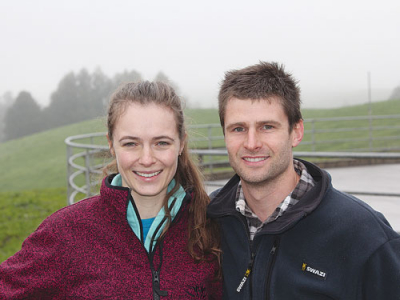 Zach and Laura Mounsey.
A trial is underway to measure the growth rates of Angus/Jersey beef calves from birth to finished product.
Initiated by Greenlea Premier Meats, the project will track about 150 Jersey x Angus calves now being born on Zach and Laura Mounsey’s Arcadia Dairies Farm near Otorohanga.
Semen from the pedigree Angus sire Matauri Crikey G244 was supplied free by Greenlea.
All calves will be transferred to calf rearer Mark Bocock for rearing to 100kg and will then be finished on Whenuakite Farm (a Pamu NZ farm) before processing at a Greenlea plant and sampling for meat quality.
Greenlea’s managing director, Tony Egan, said the three-year project will give Jersey farmers insights into the potential to increase their calf cheque by breeding to proven Angus genetics.
Traditionally, in breeding calves for finishing, Jersey farmers have lagged behind their Friesian colleagues. The prospect of breeding Jersey or crossbred cows to beef bulls often causes concern about calving ease, so this trial will give those farmers evidence on which to base future breeding decisions.
“The trial also recognises the need for meat processors to be more aligned with their farm supply chain so they can assure customers about welfare, antibiotic usage, exposure to GMOs, environmental stewardship, etc.
“The Angus trial is a small step in understanding how this can best be achieved and will benefits all participants in the chain,” Egan said.
A range of data will be collected at each stage of the calves’ growth: farmer Zach Mounsey will record birth weights, ease of calving, gestation length, etc. Growth rates and performance will be recorded by the calf rearer, Mark Bocock, and will continue when the calves move to Whenuakite for finishing using FarmIQ.
Final measurements of yield, carcase characteristics and meat quality will be recorded by Greenlea when the animal is processed. All data will be shared within the supply chain.
Egan says the calves are of particular interest because of their Jersey maternal genetics.
“Dairy and beef farmers will be interested in the results as they will provide a definitive perspective on whether it is possible to produce a quality meat product from Jersey cows.
“We are now working with Massey University to identify a masters degree student to write the completed project as a research piece,” Egan said.
Paul McGill, Pamu Farm innovation manager, applauded the project.
“The incentive for dairy farmers to breed the balance of the herd to beef genetics is clear for Friesian breeders but a question persists about the value of Jersey x beef calves for finishing. This project puts discipline into collecting insights that will be welcomed by Jersey farmers everywhere.
“The benefits to Pamu from the trial extend from the ability to link the beef genetics data with Focus Genetics, as well as an improved flow of data and information from the value chain via FarmIQ,” McGill said.
2018 calving special
The 2018 calving especially interests Zach and Laura Mounsey as they await the outcome of the mating of their mostly-Jersey herd to a pedigree Angus sire as part of the Greenlea Angus Project.
They are 50/50 sharemilkers on Zach’s parents’ farm on the outskirts of Otorohanga.
“We purchased the herd from my parents, transitioning from twice-a-day to once-a-day in December each year and averaging between 330 - 350 kgMS/cow,” Zach said.
“We have access to a runoff and want to breed the balance of the herd to beef so we can carry them on. Traditionally we’d use AI for four weeks and put Jersey bulls with the herd.
“The prospect to align with Greenlea Premier Meats in this trial was attractive because it enabled us to breed the cows to proven beef genetics with the reassurance that all calves are presold for rearing and finishing.
“Calving is going well. The first cows have come in very quick with half the herd having calved in the first two weeks. So far so good with no assisted calvings on the AB Angus calves. The calves are coming out strong and in good shape and are exceptional drinkers.”
Mounsey said the Greenlea contract, for one year, means they will likely revert to their normal pattern of four weeks of AI followed by Jersey and potentially Angus run bulls.
“Like most Jersey farmers we’ll be taking a close interest in the outcome of a trial that will influence breeding decisions in the future.”
Body Condition Score (BCS) is a critical element in managing the health and reproduction of the dairy herd.
Body condition scoring ewes at least six weeks out from mating can make a significant difference to conception rates and scanning percentages.
Hit the ground running this mating with these foundations for success.
While the recent payout announcement is not the news dairy farmers were hoping for, it’s an opportunity to review on farm performance with a specific focus on protecting your farm’s profitability.
The highly anticipated 2023 Discovery Project team has been revealed, marking an exciting milestone for New Zealand Holstein Friesian breeders.


Waikato milk processor Tatua has again declared a record milk payout to farmer shareholders, leaving other processors in the dust.
A Labour-led Government won’t be bringing back the controversial freshwater rules of 2020.
National’s much-touted free trade deal with India featured in the Rural Issues Debate at Mystery Creek, Hamilton on Wednesday night.
New Zealand's 2026-27 freshwater fishing season has opened, with anglers encouraged to head to rivers and lakes over the coming days as conditions look favourable across much of the country.
Central Otago District Council (CODC) has voted against a plan to spread treated sewage sludge from Cromwell and Alexandra on farmland near Lauder, a decision Federated Farmers says reflects strong opposition from rural residents.
Pāmu has released its FY26 Integrated Annual Report, reporting a Net Operating Profit of $113 million, more than double the $49 million recorded in FY25.
OPINION: It seems Canterbury processor Synlait is still in the doldrums.
OPINION: Get offside with New Zealand First leader Winston Peters at your own peril.