Paris Agreement: What Are the Costs and Returns to NZ?
OPINION: We are only weeks from the election, and my vote is looking for a home.




 increase font size
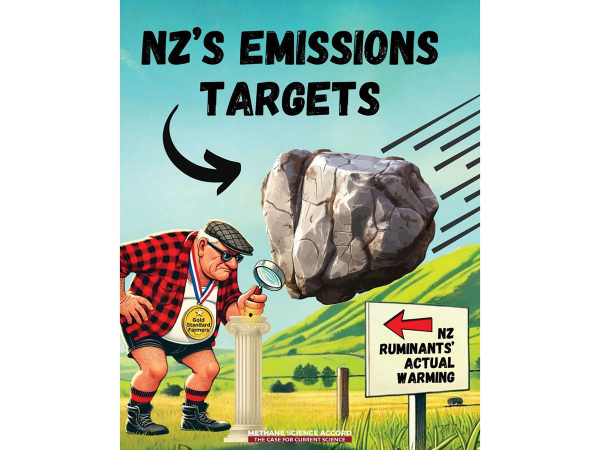 Methane Science Accord says a country grappling with economic pressures cannot afford policies that deliver no measurable global benefit.
OPINION: Back in April, the Intergovernmental Panel on Climate Change delivered an update that should have triggered an 8.5 magnitude earthquake in the world of climate change policy.
Instead, New Zealand received only a modest tremor: a letter from Climate Change Minister Simon Watts to regional and district councils. It politely draws attention to the issue and "expects" councils to review their climate assumptions. This low-key response falls short of what is needed.
The background matters. In 2014 the IPCC developed four Representative Concentration Pathways (RCPs): RCP2.6, RCP4.5, RCP6.0 and RCP8.5. In its Sixth Assessment Report (AR6, 2021), it updated these into Shared Socioeconomic Pathways (SSPs). The key scenarios include SSP1-2.6, SSP2-4.5 and SSP5-8.5.
The low-numbered pathway assumes strong global action and attaining net zero. The high-numbered one projects explosive emissions growth, including burning more coal than known reserves. The world's actual trajectory sits closer to the lower-to-intermediate range - nowhere near the extremes of the 8.5 pathways.
Crucially, the 8.5 scenarios were never intended as likely futures or "business as usual". They were designed as high-end stress tests. Yet they have repeatedly been treated as the default in modelling. This shows up across New Zealand: in Kapiti Coast planning, where thousands of properties face exaggerated sea-level rise risks; in projections of the sea lapping at Parliament's steps by 2100; and in agricultural policy. The New Zealand Agricultural Greenhous Gas Research Centre and programmes like AgriZero rely on RCP8.5 assumptions to justify major methane reduction targets and spending.
This pattern repeats in councils and government agencies nationwide. When extreme scenarios drive policy, the result is often over-regulation, inflated infrastructure costs, and misallocated resources.
Contrast this with Minister Erica Stanford's decisive action on an MBIE project plagued by cost overruns and zero results. She pulled the plug. Minister Watts and the government should show similar resolve. Rather than layering on new spending - such as the $51 million Early Adoption Accelerator for methane vaccines and boluses - they should direct a full reset: redraw all climate policies and planning using realistic, evidence-based scenarios grounded in measurable data and current trajectories.
New Zealand has faced severe weather events in recent years. Yet the IPCC itself notes limited evidence for detecting and attributing a clear human influence on many of these specific events in our region. Despite this, public discourse often defaults to alarm, amplified by models built on discredited high-end assumptions. It is no wonder many Kiwis believe cattle burps and V8 engines are the primary culprits.
A country grappling with economic pressures cannot afford billions on policies anchored in implausible scenarios that deliver no measurable global benefit. The responsible path forward is clear: prioritise robust adaptation to the climate variability we have always faced, informed by the best available science and probable futures - not worst-case fantasies. This approach has sustained humanity for millennia and remains far more cost-effective than chasing symbolic reductions with negligible real-world impact.
New Zealand's policies must reflect reality, not outdated modelling. The data demands it. Our economy and communities deserve no less.
Neil Henderson is a sheep and beef farmer in Gisborne and a founding member of Methane Science Accord.
OPINION: We are only weeks from the election, and my vote is looking for a home.

There's strong support from the horticulture sector for the Government's plans to overhaul and streamline the Recognised Seasonal Employer (RSE) scheme.
Agriculture Minister Todd McClay has admitted that a scheme bringing workers from Pacific nations to work on orchards has become too hard to navigate but says changes are coming.
OPINION: City and regional councils have been put on notice - stop using extreme climate forecasting scenarios that can drive unnecessary costs onto ratepayers.
AgriZeroNZ is ramping up efforts to accelerate the uptake of emissions reduction tools on farm with a new initiative to help more farmers put proven tools into practice.



Federated Farmers has welcomed new rural policies released by ACT, saying they align closely with its own election priorities.

Rural Contractors NZ says proposed changes to land transport rules for agricultural vehicles are a welcome response by the Government to out of date regulations which have seen members hit with huge fines.
Alliance is calling for final applications for its 2027 Graduate Programme, with applications closing on Sunday 25 October.
Decades piloting planes has ensured vet and farmer David Hayes is focused on safety. So, after a serious accident while welding on farm, he is sharing his experience so others can learn from it.
Canterbury milk processor, Synlait Milk has confirmed Leon Fung as its chief executive officer.
OPINION: Making it easier to collect rainwater and use it to grow crops and livestock is a no brainer.




OPINION: The same mainstream media muppets that brought you Jacindamania in 2017 have been flat out pimping for the Opportunities…
OPINION: Your old mate reckons the atrocious way farmers in the UK are treated by their lords and masters in…




