Resilient Global Dairy Industry Overcoming Volatility
Fonterra chief executive, Richard Allen says being resilient has helped the dairy industry overcome extreme volatility in recent years.




 increase font size
 Fonterra’s CFO Marc Rivers, chair John Monaghan and CEO Miles Hurrell fronting at this year’s annual result briefing.
Without doubt, 2018 will be remembered as Fonterra’s annus horribilis.
It is not overstating the case to say that the past year has seen a series of failures and fiascos for the dairy co-op.
For the first time, it reported a net loss for the financial year of $196 million. Meanwhile, weaker global dairy prices have forced the co-op to keep lowering its forecast payout from an opening estimate of $7/kgMS in May to $6.25 to $6.50/kgMS.
On top of this, during the year the dairy company has stumbled from one public disaster to another, notably the under-performance and over-the-top pay to former chief executive Theo Spierings, and the ongoing financial calamity of its investment in Chinese infant formula company Beingmate.
This was topped off last month, when only two of the three director positions were filled in the annual director elections, meaning another election needs to be held.
Last month’s election saw Leonie Guiney – who was ousted from the Fonterra board in 2017 – as one of the two directors elected, along with former Zespri chair Peter McBride. However, two candidates who were recommended by Fonterra’s ‘independent approval process’ were rejected by farmers.
The election process rules meant that the three failed contenders – the two board-approved and the other self-nominated candidates – were ineligible to stand again when Fonterra held a special election.
But, for some reason, the Fonterra shareholders’ council has now decided to change its own election rules. The last-minute rule change means it is holding another ballot this month and only the three candidates who failed to get over the line last time can stand.
However, incumbent director Ashley Waugh has ruled out standing again and only Jamie Tuuta and John Nicholls remain on the ballot.
No one is suggesting that either men are not credible candidates, but Fonterra’s eleventh-hour rule change looks like yet another SNAFU.
One can only hope that the upcoming vote for a new director is decisive and clear. Then Fonterra can finally put a difficult and messy 2018 behind it and head into 2019 focussed on getting its house and company performance in order.
Fonterra chief executive, Richard Allen says being resilient has helped the dairy industry overcome extreme volatility in recent years.

Northland farmer Greg Collins has taken over as chair of the Fonterra Co-operative Council.
Fonterra’s 2026 financial year was a year of delivery, with record volumes of milk collected, processed and shipped by the co-op.
Dairy farmers, still holding onto their Fonterra shares despite switching milk supply elsewhere or exiting the industry, now face a stricter share sell-down requirement.
Milk powder prices are continuing their merry run, firming up a potential $10/kgMS farmgate price this season.

During the nesting season, from September to December, industrious starlings can quickly build nests in the darker areas behind tractor and vehicle, usually close to hot engines, typically resulting in localised damage or in some cases complete write-offs.
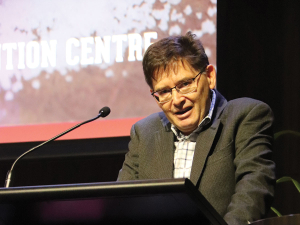
The meat processing industry is much more collegial than it was in the past and is now more focused on common goals.
With the last couple of months having seen some potential tractor purchases put on hold with the impending election and continued input cost rises, year-to-date figures, ending September, has seen deliveries up around 5% over the same period in 2025, with a total of 2026 units.
Beef+Lamb New Zealand is calling for nominations for director roles in the Northern South Island and Northern North Island electoral districts.
Fonterra chief executive, Richard Allen says being resilient has helped the dairy industry overcome extreme volatility in recent years.
The head of the Ministry for Primary Industries (MPI) trade and international relations group says New Zealand is well-positioned to secure trade access and compete internationally as the world becomes more complicated, demanding and uncertain.



OPINION: The same mainstream media muppets that brought you Jacindamania in 2017 have been flat out pimping for the Opportunities…
OPINION: Your old mate reckons the atrocious way farmers in the UK are treated by their lords and masters in…