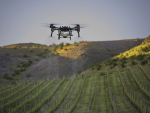
The sky is the limit at Felton Road
Felton Road Wines is using an electric drone sprayer to apply organic fungicides and monitor crops, cutting emissions and transforming management.




 increase font size
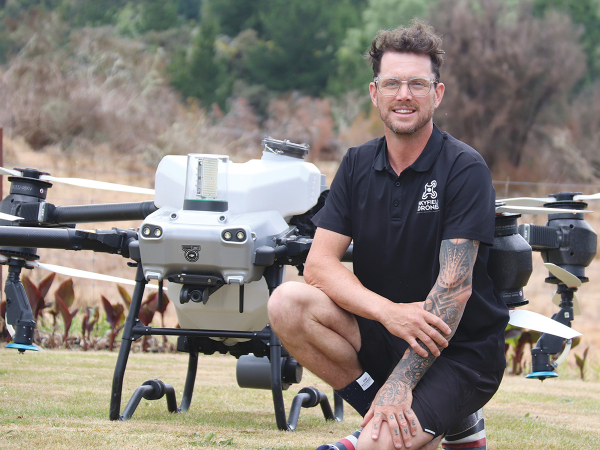 Wairarapa farmer Bradley Wadsworth also operates an agricultural drone business.
Bradley Wadsworth lives on the family farm – Omega Station – in the Wairarapa about 30 minutes’ drive east from Masterton.
He’s passionate about agriculture but is also passionate about technology and innovation and instead of opting for the conventional farming life, he’s taken a different route that he says enables him to live out his love of agriculture and do something really cool.
At the same time, he’s just got himself elected as a member of B+LNZ’s Eastern North farmer council. He took on this role because he thought as a young farmer he offered new ways of doing business and could help people – and that in this role, he would also learn.
The idea of setting up an agricultural drone business came one day when he was spraying thistles on the farm.
“I was hanging off the side of the hill and getting covered in chemicals and I thought there must be a better, easier, safer and more efficient way to do this,” Wadsworth told Rural News.
“I hadn’t heard much about drones but when I went home, I did a Google search, ended up sending a message to someone and a year later I started a drone business,” he says.
Wadsworth says he wasn’t into video games but had a background in photography and had flown drones as part of this hobby. He says he also had an interest in aviation and at one stage considered getting his sky jumper’s certificate.
A combination of working and saving hard, a bit of help from his parents and a small loan from the bank enabled him to buy the drone and then go through the comprehensive training and accreditation programme that allowed him to operate it.
“It took nearly a year, and cost was around $100,000 – including the cost of the drone and training to being able to set up my business,” he says.
The machine weighs around 50 kilograms and has the capacity to carry a load of around the same weight – be that fertiliser or a liquid spray – and there are separate tanks/hoppers for each of those uses, which are easily changed.
Niche Demand
There are a few restrictions for ag drone operators. One of these is weather and conditions must be relatively calm with a maximum of 15km of wind. The other restriction is that the operator must be able to always see the drone and that it can’t fly blind.
Bradley Wadsworth says because many of the locations he works at are remote, he has Starlink attached to his ute. This he says enables him to not only fly the drone more easily, but to have constant good communications with clients and, if there is an accident, the ability to call for help.
“When I go to a farm, I try to pick out a site to operate from that is high, which ensures a better internet connection and enables me to see the drone more easily,” he says.
So far, Wadsworth spread about 20 tonnes of fertiliser in August – a lot of work when you consider only 50kg can be carried each time. More recently he’s been busy spraying out paddocks for resowing or spraying gorse. He says when he set up the business, he assumed that it would be the young technology-minded young farmers who’d form the basis of his clients.
“But I have actually found that it is the older ones who are more receptive; the semi-retired or farmers who earlier in their careers embraced aerial topdressing and who are now keen to moves to the latest technology – the drone,” he says.
Wadworth says the drone services a niche demand and can get into small, tight areas where aircraft and trucks cannot get into easily or safely.
“This is our bread-and-butter work,” he says.
But Wadsworth also recognises that for larger operations, an aircraft, helicopter or truck are probably the best option. He says the larger drone can now carry payloads of up to 150kg, but he doubts whether they will get much bigger. He says the technology on drones will get smarter and more efficient with savings in water, chemicals and fertiliser.
Licensed To Fly
While many people dabble with drones for fun, it’s a different story if you going to run an agricultural spray and spreading business.
Bradley Wadsworth says the first step is to get a very basic license which gives you some freedom to fly the machine, followed by another step which gives you even more freedom.
“Those two steps took about a month and was a mix of online exams and the practical assessment. I also I had to go to Wellington for an interview, a theory test and then a practical one to show that I was able to fly a drone without any GPS assistance and with all the safety features turned off and control it,” he says.
After that, he had to do a two-day course to obtain his chemical certificates, then got to Auckland to prove he could fly the drone. Then finally he had to get an ag rating – like pilots of rotary and fixed wing aircraft.
“Once you do you ag rating you have to do 30 jobs under supervision and then you get signed off from that and the next step is your prime person interview with the CAA and they sign you off and say that you are capable to become a fully qualified drone pilot.”
Felton Road Wines is using an electric drone sprayer to apply organic fungicides and monitor crops, cutting emissions and transforming management.
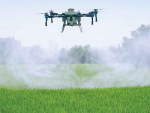
Use of agricultural drones by contractors in New Zealand is soaring.
While we are seeing more and more drones being used in New Zealand agriculture, we’re some way behind the US, where in places like the Midwest, the drones are certainly bigger than Texas.
As drones get bigger, broadacre applications like arable spraying will become more common, says the Canterburybased founder of Drone Spray, Jono Scott.
The unique attributes offered by vertical take-off and landing drones are transforming a range of civilian roles, from firefighting to traffic monitoring and now vineyard management.


Dairy processors are ready to further boost New Zealand’s export earnings but want the incoming government to match their ambition with good policy.
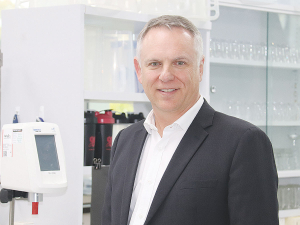
Massey University is best placed to solve the “problems” facing the dairy industry, says vice chancellor, Pierre Venter.
Synlait's longest serving employee – a man who joined the Canterbury-based milk processor even before it began processing milk – is now its newest executive.
A dairy industry leader believes eradicating the common and costly disease, Bovine Viral Diarrhoea (BVD) is within reach.
A farmgate milk price of $10/kgMS this season is firming up as milk powder prices soar and the New Zealand dollar weakens.
Federated Farmers has welcomed new rural policies released by ACT, saying they align closely with its own election priorities.

OPINION: The same mainstream media muppets that brought you Jacindamania in 2017 have been flat out pimping for the Opportunities…
OPINION: Your old mate reckons the atrocious way farmers in the UK are treated by their lords and masters in…




