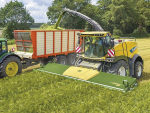
Krone XDisc 710 Now Fits John Deere, New Holland Foragers
Krone's XDisc 710 direct-cut header can now be used by John Deere and New Holland forage harvesters, as well as the Krone Big X it was originally designed for.




 increase font size
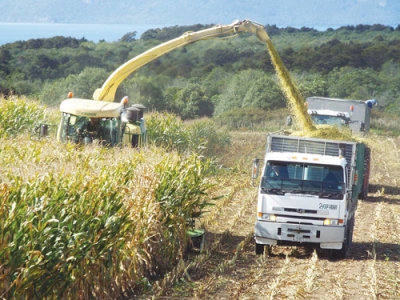 Phillip Parry Contracting’s new Krone Big X 1100 in action.
They say that X is an unknown quantity, but not so when you look at the Krone Big X range of forage harvesters.
The harvesters are gaining in popularity amongst agricultural contractors in New Zealand.
One such operator is Phillip Parry Contractors, of Mangakino, South Waikato, which recently changed a Big X 850 for a new Big X 1100, in time for the 2016 maize harvest.
Big X is certainly the right moniker for this machine: the stats make the eyes glaze and the jaw drop.
A Man V12 engine of 24L pumps out a constant 1078hp when working in applications such as maize, but it can be dialled back to a meagre 636hp for grass.
The machine tips the scales at 14.8 tonnes; add a maize header of at least 4t and 1000L of fuel and quite quickly 20t is seen and gone.
Rural News in early April watched the unit operating on a large maize block on the western shores of Lake Taupo, piloted by regular driver James Lamont.
Partnered with a 7.5m Krone Easy Collect header swallowing 10 rows of maize, progress was effortless: the operator told us a 20 tonne was crop coming in at 39.5% DM, being chopped down to around 14mm with the engine holding steady at 1900rpm. Forward speed was around 6.5km/h in steep undulating terrain, but increased to 10km/h in some flatter areas.
Lamont said the machine "never wanted for power" -- a key consideration in the owner's purchasing decision.
In Parry Contracting's region a flat field is a rarity, so trucks are often challenged in their ability to hold constant speeds with the harvester. Constant truck speed averts the need for sudden downshifts which may lead to loss of traction and a risk of getting bogged down.
A closer look at the machine revealed it is designed to shift crop quickly. It has an industry leading feed roller width of 820mm, taking crop over six hydraulically driven compression rollers to the ledger bar, before it goes to a 20 blade, 660mm diameter chopper drum with knives in a chevron pattern presenting at 11 degrees for smooth slicing and maximum output.
Chop length can be adjusted by the driver in the cab, or the Autoscan system can be used to automatically adjust chop length dependent on dry matter readings, with a decrease in length as DM increases, so ensuring good consolidation at the clamp.
In a machine of this size a smooth crop flow is vital so Krone equips the Big X with a hydraulic concave around the chopping cylinder which can move to allow any large lumps to pass, maintaining maximum output.
From the chopping cylinder crop passes through the crop processor with 144 triangular profile teeth on 250mm diameter rollers that crack the kernels and release maximum feed value. From here the crop passes through the accelerator in a constant stream to the trucks and trailers. Easy adjustment of a flap in this area serves to increase or decrease the crop speed, depending on whether filling is to the side or rear, and allowing operators to save power in the event of side fill.
This machine's capacity has killed off the traditional family farm's cutting of silage using a small trailed unit, and the arrival, 30 years ago, and evolution of self-propelled harvesters makes it unlikely those small machines will ever return.
Krone's XDisc 710 direct-cut header can now be used by John Deere and New Holland forage harvesters, as well as the Krone Big X it was originally designed for.
Already known for its extensive range of mowers, tedders and swathers, German manufacture Krone looks to be joining the trend in the swather sector, following the release of its first belt merger, the Swativo T1040 Pro.
While turnover was back slightly at €2.3 billion in 2024/2025 (previous year €2.4 billion), the German Krone Group saw earnings fall from €107 million to €40.1 million.
Ashburton-based Carrfields has announced that, from the New Year, it is officially authorised to sell Krone Forager Harvesters and Kubota Tractors across the Southland and Otago regions it represents.
Recently named Farm Machine of the Year 2026 in the forage and harvesting category at Agritechnica in Hanover, Germany, the arrival of the Krone BiG Pack HDP II 1290 Gen 6, is being touted as a major leap forward in baling technology for New Zealand farmers and contractors.


Hawke's Bay fruit growers are being reminded of the need to prepare for whatever the El Niño weather system may bring in the coming months.
Three and a half years on from when Cyclone Gabrielle hit Hawke's Bay, some orchardists in the region are still receiving counselling to help them deal with the trauma they suffered.
South of the central Hawke’s Bay town of Waipukurau is Taniwha Station – a highly successful 550ha bull beef farming operation.
Beef + Lamb NZ funded research has shown that some simple changes to pasture management could help farmers make better use of rainfall and build resilience before dry conditions hit.
OPINION: There could hardly be a more appropriate theme for a conference than the one chosen by the red meat sector - Navigating Volatility.
When Northland leather worker Vernon Suckling started making horse saddles 50 years ago, quad bikes and side-by-side vehicles were unheard of.




OPINION: The same mainstream media muppets that brought you Jacindamania in 2017 have been flat out pimping for the Opportunities…
OPINION: Your old mate reckons the atrocious way farmers in the UK are treated by their lords and masters in…




