Dry Period Sets The Platform For New Season
As spring calving cows head into dry-off, the priority shifts to one thing: setting cows up to calve at the target body condition score (BCS).




 increase font size
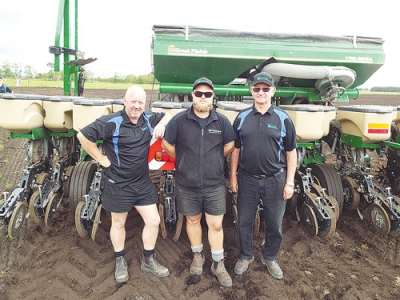 Waikato contractors Brent, Nick and Colin McFarlane beside their Great Plains maize planter.
With developments in forage maize growing over the last decade – genetics to improve yields, pest resistance and reducing days to maturity – the arrival of a new planting concept looks to give maize growers another option.
Fourth generation McFarlane Contractors at Newstead, east of Hamilton, in the heart of dairy country, have recently added a new precision planter to their fleet, which takes the technology from the US – the home of corn growing.
The Great Plains Yield Pro Twin 825A planter, while using conventional seed rates, has a layout that departs from a conventional 30 inch single row spacing and places seeds 4 inches on either side of the traditional centre-line. This results in two rows, 8 inches apart, so 16 rows over the working width. More importantly seeds are symmetrically staggered to allow each plant twice the room in each row.
The layout is said to result in a potential yield increase of 5-15% over conventional systems. With 24 inches between each pair of rows the crop can be treated post-emergence with standard implements and harvested with unmodified machines.
The construction of the machine owes much to the North American trait of lots of steel with a heavy duty drawbar. It comes with a box-section toolbar which doubles as an air reservoir for the pressurised seed and delivery fertiliser system. Hydraulics send power to the fan, machine lift and lower, markers and the folding outer wings. The machine's weight is carried by four large diameter wheels when drilling, which reduce to two for transport.
Under the toolbar, double disc openers create a tilth and are followed by Keaton seed firmers. The fertiliser and seed distribution is pneumatic, with a 1600L capacity fertiliser carried centrally above the toolbar and the 16 seed boxes mounted across the rear. The fertiliser system can deliver product at up to 400kg/ha at planting and, importantly, is placed directly between the pair of rows for best utilisation.
The seed distribution units can be switched for small round, large round and large flat seeds.
These are delivered by air pressure to the delivery plate, singulated by brush and then momentarily held before dropping down the 'clearshot' delivery tube for accurate spacing and placement.
Brent McFarlane, after watching the development of the technique in the US for six years, says they favoured exploring new technologies with the potential to increase yields.
"Using conventional seed rates of 100,000--115,000 seeds/ha but with each plant having much more room to establish a good root system – that must be good science."
He also reckons the crop canopy appears to develop much more quickly, so eliminating weeds and conserving moisture; and he believes the plant stagger will help resist lodging in exposed or windy areas.
With three weeks of long days and late nights planting behind him, McFarlane is encouraged by the emerging plants.
On the question of downsides, McFarlane commented only that he was developing muscles from now having to fill 16 seeds hoppers rather than the conventional eight.
The facts
As spring calving cows head into dry-off, the priority shifts to one thing: setting cows up to calve at the target body condition score (BCS).
Modern proprietary cultivars backed by independent data are the strong preferenced for Waikato dairy farmer Mike McGehan when he needs reliable and targeted pasture performance.
Early December marks a key transition for many dairy farmers, as weaned replacement heifers head off-farm to grazing.
I recently had the pleasure of attending an AgFirst event in Hamilton where the results of the 2024-25 Waikato-Bay of Plenty Dairy Financial Survey were shared. Based on a 136ha farm milking 379 cows, average farm profit before tax was $405,892, an incredible 286% increase on the 23-24 season.
Over the past few months, I’ve had the privilege of speaking with many farmers at events and one-on-one.

Forestry Minister Todd McClay has today congratulated the winners of the 2026 Growing Native Forests Champions Awards at Fieldays.

The Government has announced $60,000 to provide one-off grants of $1,000 to each of the 60 New Zealand Young Farmers (NZYF) clubs across the country.
New Zealand’s rural sector has once again demonstrated its generosity, with the second Rural Industry Leaders Dinner, Debate and Auction raising an impressive $400,000 for the Rural Support Trust.
There has been another twist to the Federated Farmers annual election fiasco.
Analysis of decades of research has revealed the implementation of good farming practices plays a critical role in reducing nutrient losses to improve freshwater outcomes.
Yesterday the Government used the opening of Fieldays to announce a major investment, as part of its Land Use Flexibility package, to support a more productive and sustainable future across six sectors including dairy.


OPINION: While we're on the topic of lumberjacks, Biosecurity Minister Andrew Hoggard has no doubt used a chainsaw hundreds of…
OPINION: To a chorus of crying greenies, and not a minute too soon, the Government has moved to put the…