India FTA Removes 33% Tariff on NZ Sheepmeat
New Zealand’s red meat sector has welcomed the India-New Zealand Free Trade Agreement taking effect, which removes India’s 33% tariff on New Zealand sheepmeat.




 increase font size
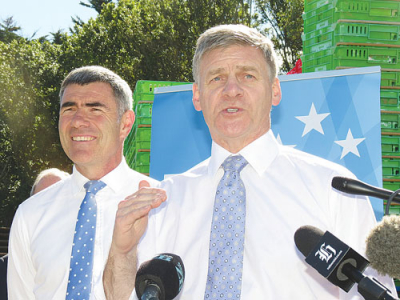 Bill English and Nathan Guy on the election campaign last week.
Technology, not taxes, is the way to deal with water related issues.
So said Prime Minister Bill English last week at a launch of the National Party’s agriculture policy at a large horticulture property in Horowhenua.
Woodhaven, a family business for 38 years, employs 205 local people. Water is a major issue for the business, especially for cleaning vegetables ready for freighting to markets in Wellington and other regions.
The company strongly opposes Labour’s proposed water tax.
English, with local MP and Minister for Primary industry Nathan Guy, told Woodhaven staff and guests that National would rename the Sustainable Farming Fund (SFF), calling it the Future Farming Fund (FFF). He says a National government would boost funding from the present $7 million to $20m a year to grow the agritech sector.
The new fund would have a cross-sector panel of industry, science and environmental groups plus other stakeholders to assess applications for funding.
“It would be aimed at getting farmers, growers and scientists to suggest effective and practical proposals.
“The water taxes and other taxes [would] suck cash out of the productive sector send it off to bureaucracies in Wellington where they [would] try to decide what [would] work best.
“Actually it is the people in the environment making the practical day-to-day decisions about plants, animals, water and effluent who know best what will work.
“We can produce more high quality food for the world and still have high environmental standards. We believe in working with you, the people who make the decisions, the people out on the tractors or wherever on the land. We want to work with you, not punish you like the opposition parties.”
English hopes the new FFF would see new apps developed for mobile phones, new genetics and better ways of propagating plants, and tools that would help farmers and growers improve production but reduce their environmental footprint.
“It’s not a matter of more production or a better environment; we are smart enough to do both. No one would say ‘to have a better environment I need to lose my job’ or ‘to have a better environment we need to have a business that is losing money’,” English says.
“The Greens say to have a better environment you have to stop doing what you are doing and you lose your job and go home.”
English also launched a stinging attack on Labour’s proposed taxes, saying they were using rural businesses like an ATM to suck cash out of the regions by way of a whole range of taxes.
New Zealand’s red meat sector has welcomed the India-New Zealand Free Trade Agreement taking effect, which removes India’s 33% tariff on New Zealand sheepmeat.
Beef + Lamb New Zealand says the National Party’s agriculture plan provides a strong basis for lifting productivity, supporting rural communities and recognising the sheep and beef sector’s environmental track record.
OPINION: Making it easier to collect rainwater and use it to grow crops and livestock is a no brainer.
National’s pledge to introduce 19 new national standards shows the party is serious about getting Wellington out of farming, Federated Farmers says.
Farmer-owned fertiliser company, Ballance Agri Nutrients is welcoming National’s plan to negotiate security agreements with key supplier countries to protect New Zealand-bound products from export restrictions and greater supply chain certainty.


Federated Farmers has welcomed new rural policies released by ACT, saying they align closely with its own election priorities.
Rural Contractors NZ says proposed changes to land transport rules for agricultural vehicles are a welcome response by the Government to out of date regulations which have seen members hit with huge fines.
Alliance is calling for final applications for its 2027 Graduate Programme, with applications closing on Sunday 25 October.
Decades piloting planes has ensured vet and farmer David Hayes is focused on safety. So, after a serious accident while welding on farm, he is sharing his experience so others can learn from it.
Canterbury milk processor, Synlait Milk has confirmed Leon Fung as its chief executive officer.
OPINION: Making it easier to collect rainwater and use it to grow crops and livestock is a no brainer.

OPINION: The same mainstream media muppets that brought you Jacindamania in 2017 have been flat out pimping for the Opportunities…
OPINION: Your old mate reckons the atrocious way farmers in the UK are treated by their lords and masters in…




