
Leon Fung confirmed as Synlait CEO
Canterbury milk processor, Synlait Milk has confirmed Leon Fung as its chief executive officer.




 increase font size
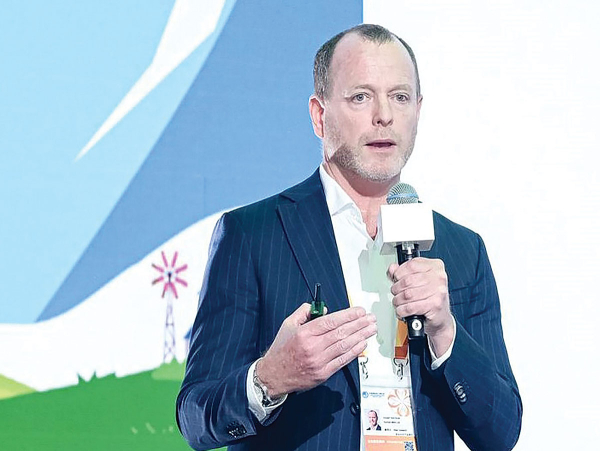 Synlait chief executive Grant Watson says the company needs to reduce capacity and use money from divestments to reduce debt.
Milk processor Synlait’s half-year numbers paint a gloomy picture.
For the six months ending January 31, the listed company recorded an after-tax loss of $96.2m and a working capital deficit of $204.9m.
Add loans and borrowings due for repayment and/or refinancing in the next twelve months of $514m – secured syndicated senior debt of $334m and unsecured subordinated retail bonds of $180m, the company faces an uphill battle to turn around its fortunes this year.
Chief executive Grant Watson told a briefing last week that the company had too much unutilised capacity and too much debt. He says the company needs to reduce capacity and use money from divestments to reduce debt.
Watson added that Synlait is banking on deleveraging, a business recovery plan and strengthened leadership to ride out the storm. Potentially on the chopping block is the five-year old stateof- the art Pokeno plant, south of Auckland, which is operating below capacity. Meanwhile, a blending and canning plant in Auckland is also possibly up for sale.
In the first half of the 2024 financial year, the company wrote down $50m because of underutilisation of North Island assets. The assets are valued around $400 million. A strategic review of these assets is underway and a decision of whether to sell all of part of the assets will be made later this year.
There’s also Dairyworks, a cheese making business that Synlait bought in 2020 for $112m. The company has poured money into Dairyworks, which is now valued around $120m following a $30m write down this year. Dairyworks has been on the market since last year.
Watson says Synlait will ensure that any assets sales will provide maximum return for shareholders.
Synlait is also toying with the idea of a capital raise. While Bright Dairy, which owns 39% of Synlait, is on board for a capital raise, second largest shareholder a2 Milk Company hasn’t been consulted. Watson says if they decide to embark on a capital raise, a2MC, which holds 19% stake in Synlait, will be consulted.
The company’s banking syndicate has agreed to extend a $130 million prepayment from March 28 to July 15 this year and provided an additional $30 million of short-term funding for the next three months.
Watson notes that significant loan repayments will fall due during the next 12 months and successful execution of deleveraging options will be required to meet repayment obligations.
“Without successful deleveraging, Synlait may not be able to meet financial obligations as they fall due,” he says. “There will be material uncertainties associated with the timing and outcome of these deleveraging options.”
Synlait’s balance sheet reset initiatives are underpinned by a letter of support from its largest shareholder, Bright Dairy.
“Bright Dairy’s support, coupled with the banking amendments, offers Synlait additional stability, and confirms that our largest shareholder and our banking syndicate remains very supportive,” Watson adds.
“As well as establishing a clear deleveraging plan for our balance sheet, we have highlighted several forward-looking initiatives as part of our well-progressed business recovery plan to accelerate volume growth and further optimise our manufacturing, quality, and cost performance.”
Watson says Synlait was founded as an entrepreneurial, innovative, disruptive, and sustainable company.
However it has long faced significant strategic risk around a lack of customer and product diversification and in response the company has invested in capacity expansion and category diversification.
“More recently we made the decision to refocus our strategy on areas where we have a clear competitive advantage to deliver diversified, high-value growth. It is important we do not lose our competitive advantage.”
Canterbury milk processor, Synlait Milk has confirmed Leon Fung as its chief executive officer.
Waikato milk processor Tatua has again declared a record milk payout to farmer shareholders, leaving other processors in the dust.
Synlait has swung to second-half profit as operations stabilise, but the dairy processor still posted a $75.4m annual loss.
OPINION: It seems Canterbury processor Synlait is still in the doldrums.
Speculation of a possible joint move by Fonterra and a2 Milk to buy Synlait raises a much bigger strategic question, says agribusiness expert Dr Nic Lees.


Federated Farmers has welcomed new rural policies released by ACT, saying they align closely with its own election priorities.

Rural Contractors NZ says proposed changes to land transport rules for agricultural vehicles are a welcome response by the Government to out of date regulations which have seen members hit with huge fines.
Alliance is calling for final applications for its 2027 Graduate Programme, with applications closing on Sunday 25 October.
Decades piloting planes has ensured vet and farmer David Hayes is focused on safety. So, after a serious accident while welding on farm, he is sharing his experience so others can learn from it.
Canterbury milk processor, Synlait Milk has confirmed Leon Fung as its chief executive officer.
OPINION: Making it easier to collect rainwater and use it to grow crops and livestock is a no brainer.




OPINION: The same mainstream media muppets that brought you Jacindamania in 2017 have been flat out pimping for the Opportunities…
OPINION: Your old mate reckons the atrocious way farmers in the UK are treated by their lords and masters in…




