
Laneve: Wools of NZ Launches Online Wool Carpet Service
Wools of New Zealand chief executive John McWhirter says its new direct-to-consumer wool carpet service, Laneve, is the next step in the development of the business.




 increase font size
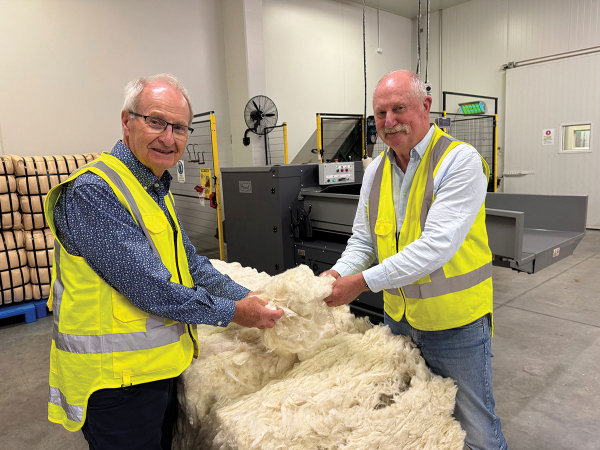 John McWhirter, Wools of NZ chief executive (left) and Keraplast chief executive Howard Moore have stitched a new superpremium wool contract.
Keratin biomaterials company Keraplast and Wools of New Zealand have signed a new superpremium wool contract which is said to deliver a boost to wool growers.
The contract includes a $6.88/ kilogram clean price for the 2025/26 financial year – approximately a 40% premium to 2025 marketing.
It covers an estimated 400 tonnes of wool over five years from approximately 30 New Zealand growers.
John McWhirter, chief executive of Wools of New Zealand, says the contract represents a significant lift for strong wool growers and a clear vote of confidence in the future of New Zealand wool.
“For participating growers, the agreement provides price certainty, demand security and access to a rapidly growing global biomaterials market,” McWhirter says.
“This price is around $2/kilogram ahead of the current market, which is a meaningful premium for farmers.
“It shows that when wool is connected directly to high-value end uses, returns can lift well beyond traditional commodity pricing. That is exactly where Wools of New Zealand is focused,” he says.
The wool will be supplied to Keraplast, which manufactures advanced biomaterials using keratin.
Through a controlled manufacturing process, keratin extracted from strong wool is transformed into a range of high-value materials used in medical, nutraceutical and personal care applications, including wound care products, tissue repair and hair and skin care. These products are sold into global markets, including the United States, Europe and Asia.
Keraplast chief executive Howard Moore says New Zealand wool offers clear advantages over alternative keratin sources used globally.
“Wool-derived keratin ingredients, manufactured through Keraplast’s sciencebased process technology, deliver functionality that is highly suited for medical, nutraceutical and personal care uses,” Moore says.
“The consistency, traceability and quality of New Zealand wool is critical to Keraplast’s product performance,” he adds.
“New Zealand strong wool gives us a reliable, high-performing raw material and the regenerative farming systems behind it align strongly with our values and our customers’ expectations,” he concludes.
Wools of New Zealand chief executive John McWhirter says its new direct-to-consumer wool carpet service, Laneve, is the next step in the development of the business.

Wools of New Zealand is joining calls for New Zealand to urgently ratify a Free Trade Agreement with India.
Wool farmers are hoping that efforts by two leading companies to develop a more efficient supply chain would eventually boost farmgate returns.
Wools of New Zealand has signed a partnership agreement with a leading Chinese manufacturer as the company looks to further grow demand in China and globally.
Chinese textile company Saibosi has partnered with Wools of New Zealand to put the 'farm to floor' story of New Zealand wool rugs on screen for its customers.


Federated Farmers has welcomed new rural policies released by ACT, saying they align closely with its own election priorities.

Rural Contractors NZ says proposed changes to land transport rules for agricultural vehicles are a welcome response by the Government to out of date regulations which have seen members hit with huge fines.
Alliance is calling for final applications for its 2027 Graduate Programme, with applications closing on Sunday 25 October.
Decades piloting planes has ensured vet and farmer David Hayes is focused on safety. So, after a serious accident while welding on farm, he is sharing his experience so others can learn from it.
Canterbury milk processor, Synlait Milk has confirmed Leon Fung as its chief executive officer.
OPINION: Making it easier to collect rainwater and use it to grow crops and livestock is a no brainer.





OPINION: The same mainstream media muppets that brought you Jacindamania in 2017 have been flat out pimping for the Opportunities…
OPINION: Your old mate reckons the atrocious way farmers in the UK are treated by their lords and masters in…




