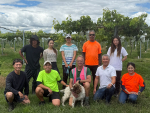
Global team cultivates New Zealand premium eating grape vineyard
A multi-cultural team is helping to establish one of New Zealand's largest plantings of premium eating grapes - while learning each other's languages and cultures along the way.



 increase font size
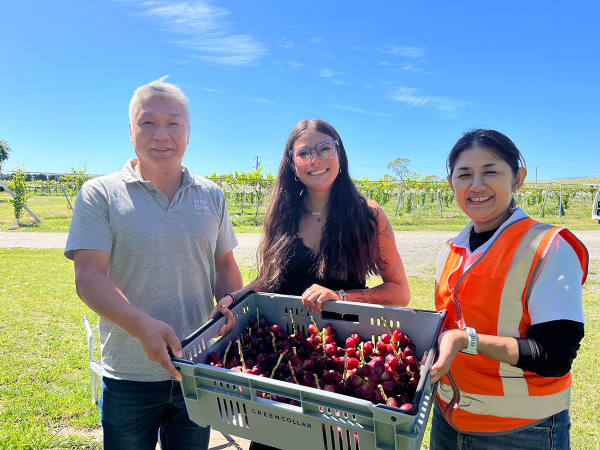 Greencollar’s harvest is running up to a month earlier than last year.
Budou are being picked now in Bridge Pā, the most intense and exciting time of the year for the Greencollar team – and the harvest of the finest eating grapes is weeks earlier than expected.
The team has mobilised, from harvesters to packers, with the retail team preparing to be at the Hawke’s Bay Farmers’ Market for two Sundays from March 8, after two Saturdays with the early picks at the Black Barn Growers’ Market in February.
Grapes will be shipped to New Zealand’s main centres, and to Japan, China and the USA. In Hawke’s Bay they will be starring at several of Hawke’s Bay’s premium restaurants..
The harvest of premium eating grapes comes as Hawke’s Bay wine grape growers also report an earlier-than-usual vintage this season. Greencollar’s harvest is running up to a month earlier than last year. With fewer than 40 hectares of eating grapes in commercial production nationally, the 20-hectare Maraekakaho planting is one of the largest in New Zealand.
After a year of meticulous pruning, thinning and nurturing, the work of an entire season will be completed in just weeks. Each bunch must be picked at precisely the right point for flavour, texture and appearance, and shipped immediately.
Chief executive Shin Koizumi says the compressed season heightens both the pressure and the reward. “We spend all year preparing for this moment. Every decision - pruning, thinning, protecting the fruit - leads to these few weeks. It is intense, but it is also the most rewarding time of the year.”
Unlike wine grapes, which are harvested for juice, eating grapes must meet exacting standards for presentation as well as taste. “We are focused on the whole presentation: taste, flavour, balance and look – everything needs to be perfect.”
A multi-cultural team is helping to establish one of New Zealand's largest plantings of premium eating grapes - while learning each other's languages and cultures along the way.

With the first harvest of high-quality table grapes from 700 vines just completed, the attention of Japanese company Greencollar is on preparing to harvest from 1400 vines next summer, and putting in another 1500 this planting season.
Divine table grapes that herald the start of a brand-new industry in Hawke’s Bay have been coming off vines in Maraekakaho.


Federated Farmers has welcomed new rural policies released by ACT, saying they align closely with its own election priorities.

Rural Contractors NZ says proposed changes to land transport rules for agricultural vehicles are a welcome response by the Government to out of date regulations which have seen members hit with huge fines.
Alliance is calling for final applications for its 2027 Graduate Programme, with applications closing on Sunday 25 October.
Decades piloting planes has ensured vet and farmer David Hayes is focused on safety. So, after a serious accident while welding on farm, he is sharing his experience so others can learn from it.
Canterbury milk processor, Synlait Milk has confirmed Leon Fung as its chief executive officer.
OPINION: Making it easier to collect rainwater and use it to grow crops and livestock is a no brainer.


OPINION: The same mainstream media muppets that brought you Jacindamania in 2017 have been flat out pimping for the Opportunities…
OPINION: Your old mate reckons the atrocious way farmers in the UK are treated by their lords and masters in…




