Aiming for homegrown NZ gin
Despite a plethora of new gins appearing all over NZ, the country is yet to grow local juniper berries at any scale for gin production or for export.




 increase font size
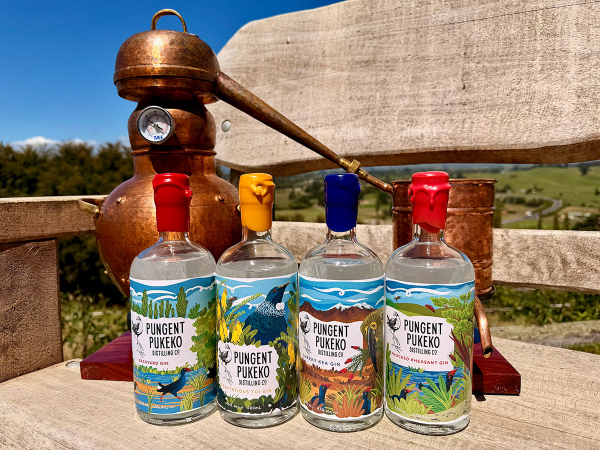 Pungent Pukeko recently won Gold at the World Gin Awards.
“We’re not normal.” That’s how Jack Walters, executive director of Pungent Pukeko, describes his gin brand, which has just won gold at the World Gin Awards.
“It’s pretty epic,” Walters told Rural News of the win. “It’s not something you expect in your second year.”
The story of Pungent Pukeko started with an ad on Facebook.
“I’m a bit of a magpie when it comes to shiny things,” Walters says. “I came across an ad on Facebook by Alembics that were advertising distilling courses and had footage of beautiful handmade copper stills and fresh produce.
“I really wanted one, but couldn’t originally justify the expense.”
It wasn’t long before Walters had purchased two stills – a small 3L in which he could develop recipes, and a larger 20L still for commercial purposes, which Walters says is “incredibly small” for a commercial operation.
Since then, he has visited Alembics director Jill Mulvaney at her laboratory on Waiheke Island twice.
“She’s taught me most of what I own,” he says.
Having grown up on a dairy farm, Walters thought it best to use a dairy byproduct for the base spirit: Lactanol, an ethyl alcohol produced from whey.
“Taste wise, it [Lactanol] is very neutral, more neutral than grain or sugar cane, and I think if you use it in a certain way… you get quite a creamy, smooth texture from it,” he says. “It doesn’t hit you harsh and it doesn't have any other foul notes that you’ve got to be careful of.”
Another point of difference for Pungent Pukeko? The brand grows many of the botanicals use to flavour the gin.
“We use many fresh herbs and native plants in our gins, so having them onsite allows us to get them in the still immediately and retain a high level of volatile compounds, which give the flavour,” Walters says.
He says some have suggested drying the botanicals, however some of the botanicals lose the flavour profile and in other cases, the dried versions – even in small quantities – come across harsher in the end product.
“Besides the ones that you have to import, like juniper, and to an extent angelica and licorice… I’d rather keep everything in New Zealand, keep it all local, support local growers, and you get a better flavour,”
When asked what was next for the brand, Walters says there “quite a few little things in the works”.
 |
|---|
|
Pungent Pukeko grows many of the botanicals used to flavour the gin. |
He says there are plans to export the gin, but there are also to go bigger.
“At the moment the distillery is at home attached to a shed,” he says. “Eventually, it would be good to have our own plot with a dedicated distillery, restaurant, bar and a full kind of farm to glass experience to the point that, maybe it’s a little bit mad, but have a fully off the grid farm.”
He says that he’d like for Pungent Pukeko to be fully self-sufficient, “to the point that if you wanted to use flour in a dish, you would mill it yourself from your own kind of wheat”.
However, he says, this is “a good decade or two away”.
He says he wants to stay near Otorohanga, where the Pungent Pukeko story started.
“Mainly at this stage, we’re just looking for little collaborations, maybe get some canned drinks done. There’s been ideas of somehow incorporating gin into chocolate truffles, lots of little niche things that you wouldn’t usually see,” he says.
“I don’t want to be normal, we’re not normal,” he concludes.
Despite a plethora of new gins appearing all over NZ, the country is yet to grow local juniper berries at any scale for gin production or for export.


A major move is about to get underway to improve the quality and viability of dairy beef and cattle in NZ.
Veterinarians say changes to the code of welfare for dairy cattle provides a positive foundation for improved cattle welfare across the country.
Today, 15 October, is the International Day of Rural Women, which recognises rural women’s contribution to farming, communities and the environment.
Global dairy giant Lactalis has integrated its Australian operations with the Mainland Dairy consumer business it acquired from Fonterra earlier this year.
After almost two decades of sharemilking, saving and building equity, Aaron and Marcia Flay this year realised their long-held dream of settling on their first dairy farm.
Good medium to long term prospects for NZ beef, especially in the US, has heighted the focus on various initiatives to capitalise on this situation.




OPINION: The same mainstream media muppets that brought you Jacindamania in 2017 have been flat out pimping for the Opportunities…
OPINION: Your old mate reckons the atrocious way farmers in the UK are treated by their lords and masters in…




