Dawn Meats acquires German distributor Alexander Eyckeler GmbH
Irish meat processor Dawn Meats has acquired Alexander Eyckeler GmbH, a long-standing German customer and partner of Alliance Group, for an undisclosed sum.




 increase font size
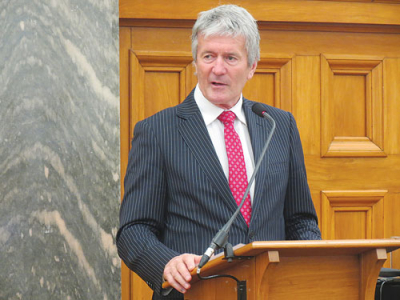 Damien O’Connor.
Ag Minister Damien O’Connor told the International Conference on Agricultural GHG Emissions and Food Security, held in Berlin last week, that NZ is spending large on R&D to identify options to reduce agricultural emissions.
He says while NZ is a small country, it remains clear about its responsibility to bring about positive changes in this area on a global scale.
O’Connor repeated PM Jacinda Ardern’s claim that the NZ government “regards climate change as the nuclear-free movement of the modern generation”.
“As a global community we need to deliver more food of a higher quality with less environmental impact than ever before. We need to reduce agricultural emissions, while maintaining strong economies and productive and resilient sectors capable of meeting the food demand of an exponentially growing world population,” he told the conference.
O’Connor says NZ has a low population density and a temperate climate, ideal for agricultural production. He says through innovation and impressive productivity gains – helped by the removal of agricultural subsidies and tariffs in the 1980s – NZ can produce more food more efficiently than ever before.
He noted that NZ is the number-one dairy exporter in the world, but only produces 3% of the world’s milk. Also the country ranked number-six beef exporter in the world, but only produces 6% of the world’s beef.
O’Connor told attendees about NZ’s Sustainable Land Management and Climate Change research programme (SLMACC), set up to help NZ meet international greenhouse gas reduction goals and maintain profitable and sustainable agriculture and forestry sectors in the face of a changing climate.
“In the decade since its inception we have funded over 150 projects with $50 million of Government funding – some with returns 10 times the original public investment. As a Government, we have stated clearly that we want clean water and a low emissions economy and we are working through these challenges carefully and pragmatically with the farming sector, whose efforts in these areas are strong and a story worth sharing.
“In the spirit of what we call kaitiakitanga, or guardianship, our work is not just about preservation, but wise utilisation of our natural resources and understanding how to best match land use to different production types and regions.”
O’Connor says NZ has long held the view that more can be achieved through collaboration than alone. This inspired us to lead the set-up of the Global Research Alliance in 2009.
“The GRA’s aim is to bring countries together to find ways to grow more food without growing greenhouse gas emissions. It achieves this by increasing international cooperation, collaboration and investment in public and private research by its 50-member countries.”
O’Connor told the conference that NZ has spent $65m over the last nine years to support the GRA to accelerate and expand global research in livestock, soils and measurement.
He says in the livestock sector NZ has found promising leads. “By working with others, we’ve measured thousands of animals and have been able to identify some that emit lower levels of methane.
“We’ve screened hundreds of thousands of chemical compounds and isolated a handful that have large potential to reduce emissions. We’re undertaking world-leading research to try to develop a vaccine to reduce methane from livestock.
“We’ve carried out a global survey of ruminant animals including sheep, cattle, deer, goats, buffalo and even giraffes, and we discovered that the same groups of microorganisms dominate in nearly all rumens across a wide variety of species and animal diets.”
O’Connor says this study involved at least 140 scientists in 73 organisations in 34 countries.
Irish meat processor Dawn Meats has acquired Alexander Eyckeler GmbH, a long-standing German customer and partner of Alliance Group, for an undisclosed sum.

Alliance has announced two key appointments within its senior leadership team.
Alliance Group and the Southland Stags rugby team have joined forces in a partnership that will see the the meat co-operative's farmgate brand feature on players' team kits and replica jerseys.
Alliance Group chief executive Willie Wiese is leaving the company after three years in the role.
Alliance Group has commissioned a new heat pump system at its Mataura processing plant in Southland.


FarmIQ Systems has developed a free land management app to help remove barriers to New Zealand farmers and growers adopting digital tools.

Rural Women New Zealand has announced the winners of the 2026 NZI Rural Women Business Awards.
Horticulture NZ says the funding boost to improve state highway resilience will support growers and strengthen the transport links they rely on to get produce to market.
Gallagher has appointed Rob Clayton as Chief Executive of its global Animal Management business to lead the next stage of growth across key markets.
A Waihi dairy farmer, Keith Torrens, has been convicted and fined $39,000 for the unlawful discharge of dairy effluent following a prosecution taken by Waikato Regional Council.
Taranaki's sunshine and energy sector expertise are powering a new approach to renewable energy, with the launch of BlueGreen Frontiers.



OPINION: While we're on the topic of lumberjacks, Biosecurity Minister Andrew Hoggard has no doubt used a chainsaw hundreds of…
OPINION: To a chorus of crying greenies, and not a minute too soon, the Government has moved to put the…