
India FTA Removes 33% Tariff on NZ Sheepmeat
New Zealand’s red meat sector has welcomed the India-New Zealand Free Trade Agreement taking effect, which removes India’s 33% tariff on New Zealand sheepmeat.




 increase font size
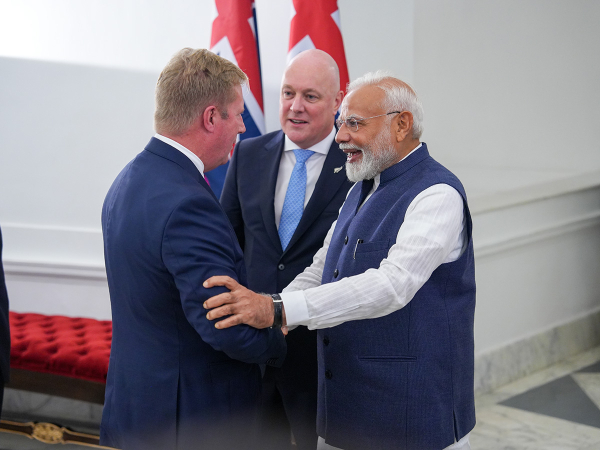 Todd McClay, Christopher Luxon, and Indian Prime Minister Narendra Modi on the visit to India in March 2025 where the NZ-India FTA was launched.
New Zealand and India have signed a Free Trade Agreement (FTA) described as a once-in-a-generation deal.
Yesterday, Trade and Investment Minister Todd McClay and India's Minsiter for Commerce and Industry Piyush Goyal met in New Delhi and signed the agreement in front of a crowd of New Zealand and Indian businesspeople.
The deal eliminates or reduces tariffs on 95% of New Zealand's exports to India.
It ensures that close to 57% of New Zealand exports will be duty free from day one of the deal, including lamb, wool and forestry.
This will increase to 82% when fully implemented including infant formula, a kiwifruit quota almost four times the current exports and seafood.
The remaining 13% including kiwifruit, apples, mānuka honey, wine and some dairy products is subject to sharp tariff cuts.
New Zealand Prime Minister Christopher Luxon says the benefits of the deal are widespread, adding that the country's business community is excited to see the doors open to 1.4 billion people in an economy set to become the world's third largest.
"One in four jobs are tied to trade," Luxon says.
"In signing this FTA we are setting businesses up to succeed, boosting Kiwi jobs and enabling economic growth – and that means more money in Kiwis’ pockets.”
McClay says the FTA supports New Zealand's goal to double the value of exports in 10 years.
"This deal will deliver thousands of jobs and billions of dollars in additional exports," he says.
“Creating opportunities for our businesses to diversify and create strong trading relationships provides economic security for New Zealanders – and that is crucial in these times of global unrest.”
The Government argues the signing ensures that New Zealand is on track to benefit from a Most Favoured Nation clause for wine and services exports, meaning Kiwi exporters will have better access if the deal comes into force before the European Union's deal.
“That clause will be worth tens of millions of dollars in extra exports for the New Zealand economy,” Luxon says.
“Two-way trade is currently NZ$3.95 billion. The deal we have struck and the relationship we have built will grow this exponentially and deliver deep and lasting benefits for generations to come.”
New Zealand's red meat sector says it welcomes the signing of the FTA and its potential to unlock opportunities over time.
Meat Industry Association (MIA) chair Nathan Guy says that once ratified, the FTA will expand New Zealand red meat exporters’ trade options in a challenging global environment.
“Exporters are operating in a world of rising protectionism and ongoing volatility. Having a broader mix of markets and expanding our reach will help spread risk and provide more stability for farmers and exporters," Guy says.
“India is a market with significant long-term potential. While we won’t see immediate gains, this FTA charts a path to improve market access and create new opportunities for the red sector.”
Meanwhile, Beef + Lamb New Zealand chair Kate Acland says the agreement positions New Zealand in a market with strong promise.
“India is now the world’s most populous country and is expected to become the third-largest economy within the next five years. As incomes rise in India, so will demand for high-quality natural protein.
“Access has been constrained due to a 30 per cent tariff on New Zealand sheepmeat. This FTA will start the process of addressing those barriers and puts us in a stronger position as the market develops.
“The FTA can help build the red meat sector’s resilience and enable us to keep delivering for the New Zealand economy.”
The New Zealand Forest Owners Association (NZFOA) has also joined the chorus of primary sector voices welcoming the deal.
Elizabeth Heeg, NZFOA chief executive, who was in India for the signing says it is an honour to witness the progress of an agreement with such significant potential for New Zealand forestry.
“Forest growers welcome the signing of this agreement. India is a large, fast-growing economy and an increasingly important partner for New Zealand.
"Wood and wood products are already New Zealand’s largest goods export to India, worth NZ$134 million in the year to June 2025, giving our sector a strong base to build from.
"Improved access to the Indian market gives forest growers, wood processors and exporters greater confidence to invest, grow trade and support jobs across the forestry supply chain.”
The deal is set to be ratified by the Government later this year following much political debate.
Signing of the FTA activates the standard parliamentary process, allowing Parliament and the public to scrutinise the agreement through the Select Committee. The FTA text and National lnterest Analysis will be tabled in Parliament today and referred to the Foreign Affairs, Defence and Trade Committee (FADTC).
Once FADTC has completed its examination, enabling legislation will be introduced and will follow the usual legislative process. This approach is consistent with that taken for the TPP, CPTPP, and agreements with the United Kingdom, European Union, and United Arab Emirates.
New Zealand’s red meat sector has welcomed the India-New Zealand Free Trade Agreement taking effect, which removes India’s 33% tariff on New Zealand sheepmeat.

More than 95 per cent of New Zealand’s forestry and wood exports to India can now enter tariff free as the New Zealand-India Free Trade Agreement comes into force today.
Zespri has welcomed the entry into force of the India-New Zealand Free Trade Agreement today, calling it a significant milestone that will support long-term growth in one of the world’s largest and fastest-growing consumer markets.
As part of its Election 2026 coverage, Rural News asked political parties how they would help pull the arable sector out of the doldrums. Here's what they said:
Food and fibre exports have returned a billion- dollar bonus to the country.


Federated Farmers has welcomed new rural policies released by ACT, saying they align closely with its own election priorities.

Rural Contractors NZ says proposed changes to land transport rules for agricultural vehicles are a welcome response by the Government to out of date regulations which have seen members hit with huge fines.
Alliance is calling for final applications for its 2027 Graduate Programme, with applications closing on Sunday 25 October.
Decades piloting planes has ensured vet and farmer David Hayes is focused on safety. So, after a serious accident while welding on farm, he is sharing his experience so others can learn from it.
Canterbury milk processor, Synlait Milk has confirmed Leon Fung as its chief executive officer.
OPINION: Making it easier to collect rainwater and use it to grow crops and livestock is a no brainer.




OPINION: The same mainstream media muppets that brought you Jacindamania in 2017 have been flat out pimping for the Opportunities…
OPINION: Your old mate reckons the atrocious way farmers in the UK are treated by their lords and masters in…




