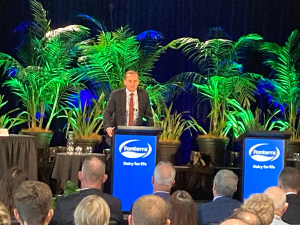
Environment Minister Amy Adams revealed, in the past week, the changes to be contained in an amendment to the RMA to be introduced into Parliament probably before the end of the year.
She told Rural News the changes will see the act simplified, streamlined and updated to bring greater certainty to communities and individuals and cost them less. Adams acknowledges there’s been a lot of criticism of the RMA by the rural sector.
“We’ve seen some pretty worrying stats from Horticulture New Zealand about the impact it has on their operation and their levy payers and I think that is shared right across the rural sector,” she says.
Adams says the amendments to the RMA will ensure processes give people greater certainty and tighten-up timeframes for approving resource consents. She also notes there are examples of councils charging far too much for minor consents and demanding consents for activities which, she says, hardly warrant one.
Adams says the present system is complex and she notes that New Zealand has 170 different planning documents among 78 councils, whereas Scotland – with greater population than New Zealand – has just 37 equivalent planning documents. She believes her changes will require a culture shift on the part of councils.
“There is nothing in the present RMA that requires the creation of an inconsistent, sluggish, bloated system we now have. But there is also nothing to stop this happening. So what I have had to do is to go back to first principles and see how we can recalibrate the RMA system to take away the opportunity for it to blow out to the sort of bureaucracy that we currently have.”
At issue are the decisions we ask councils to make, whether they can be made more sensibly from the centre and how we can focus on really local applications of these issues, Adams says. Some problems today are not the fault of councils, rather a lack of ‘national direction’ by central government has been partly to blame.
She is staggered by a lack of understanding about what the RMA actually is, and a perception of it being only about the environment.
“We’ve seen a lot of people jump up and say things like ‘economics has no place in the RMA’ which I find a staggering assertion. But actually the wording of the ‘purpose clause’ in the act makes it clear it is looking after our economic, environmental, social and cultural objectives and it is our planning legislation.
“Yes it does have a role in protecting the environment, but it is also our planning law and far and away the absolute bulk of what goes through the RMA processes is planning decisions. Such things as how high a building can be and where we put the next supermarket. They are all planning decisions.”