Fonterra Elections 2026: Voting Opens Tuesday 20 October
Fonterra shareholders can begin voting on Tuesday 20 October in the 2026 Board of Directors’ election, a Co-operative Council election in one Ward, and seven Annual Meeting resolutions.




 increase font size
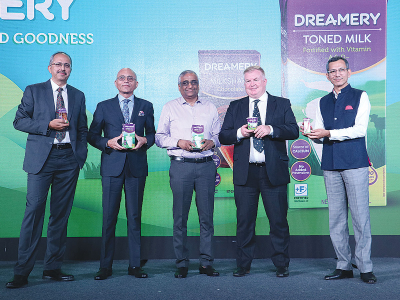 From Left to right: Fonterra Future chief executive Ishmeet Singh, Fonterra India and Sri Lanka managing director Sunil Sethi, Future Group chief executive Kishore Biyani and Fonterra strategic portfolio management director Chris Gree.
Fonterra's re-entry into the lucrative Indian market comes after years of homework, claims Fonterra India/Sri Lanka managing director Sunil Sethi.
He says India’s dairy market has evolved over the last 12 years and the co-op is well placed to use its dairy expertise to meet the needs of Indian consumers.
Last week Fonterra launched its Dreamery brand of dahi (curd), UHT toned milk and chocolate and strawberry milkshakes in Mumbai.
This is the co-op’s second foray into India since its inception. In 2001, Fonterra formed a joint venture with Bangalore-based Britannia Industries, but pulled out in 2009, saying at the time that it no longer fitted its strategic priorities.
Sethi says India now has a very different dairy industry. Consumer tastes have changed and they are now open to innovation. Logistics and cold chain systems there have vastly improved.
Fonterra hopes to have a full range of Dreamery dairy products on sale there within two years, using milk sourced in India. And Sethi says Fonterra will also tap into India’s growing food service business by supplying products made in New Zealand.
Consumer demand for dairy in India over the next seven years is expected to increase by 82 billion litres -- seven times the growth forecast for China.
“India consumes 170 billion litres of milk every year... the opportunity is huge,” Sethi told Rural News.
The joint venture partner, Future Group, is present in 26 of 31 Indian states with at least 2000 modern trade outlets and 5000 public distribution outlets and a nationwide cold chain and ambient distribution network.
Sethi will chair the joint venture board with three representatives each from Fonterra and Future Group.
Chairman John Monaghan and chief executive Miles Hurrell visited India a month ago for an update on the joint venture.
A good time
Former Fonterra director Earl Rattray believes the timing is right for the co-op to re-enter India.
Rattray, who has dairy farming interests in India, says the country is going through a massive transition.
“This is visible in rising consumer aspirations and expectations around what they buy and where they buy it,” he told Rural News.
Rattray is impressed with Fonterra’s tie-up with the Future Group.
“They are one of these ‘new age’ companies which will transform India, quite a positive disrupter in the market, and run more like what we are used to in terms of corporate governance. It’s a bit like a Walmart of India, except they are Indian, and you need to be to understand the Indian consumer.”
Rattray says the Indian market has come a long way since Fonterra’s first foray with Britannia.
“The focus of that joint venture was initially on fresh white milk across the country, almost the only category at that time. It was competing with established companies which do things differently from what we are used to, and it was competing with the massive informal trade.”
Fonterra shareholders can begin voting on Tuesday 20 October in the 2026 Board of Directors’ election, a Co-operative Council election in one Ward, and seven Annual Meeting resolutions.

Fonterra Co-operative Group chief financial officer Andrew Murray has resigned to take up a role outside the dairy giant.
Four candidates have been confirmed for two director positions on Fonterra’s board.
A record farmgate milk price and strong global demand is laying the foundation for continued growth of organic dairy farming in New Zealand.
Waikato milk processor Tatua has again declared a record milk payout to farmer shareholders, leaving other processors in the dust.


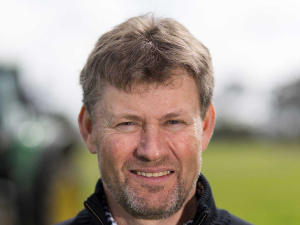
Mark Hooper has been appointed the new chair of NZPork, the industry organisation representing New Zealand pig farmers.
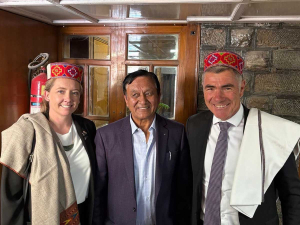
As the India-New Zealand free trade agreement enters into force, New Zealand’s apple industry has reaffirmed its commitment to the long-term development of India’s apple sector.
Fonterra shareholders can begin voting on Tuesday 20 October in the 2026 Board of Directors’ election, a Co-operative Council election in one Ward, and seven Annual Meeting resolutions.
National’s pledge to introduce 19 new national standards shows the party is serious about getting Wellington out of farming, Federated Farmers says.
The National Party’s policies to make it easier to grow fresh vegetables, secure reliable water and energy and simplify farm planning are practical changes that will give growers the confidence to invest, according to Horticulture New Zealand (HortNZ).
Fonterra Co-operative Group chief financial officer Andrew Murray has resigned to take up a role outside the dairy giant.




OPINION: The same mainstream media muppets that brought you Jacindamania in 2017 have been flat out pimping for the Opportunities…
OPINION: Your old mate reckons the atrocious way farmers in the UK are treated by their lords and masters in…




